
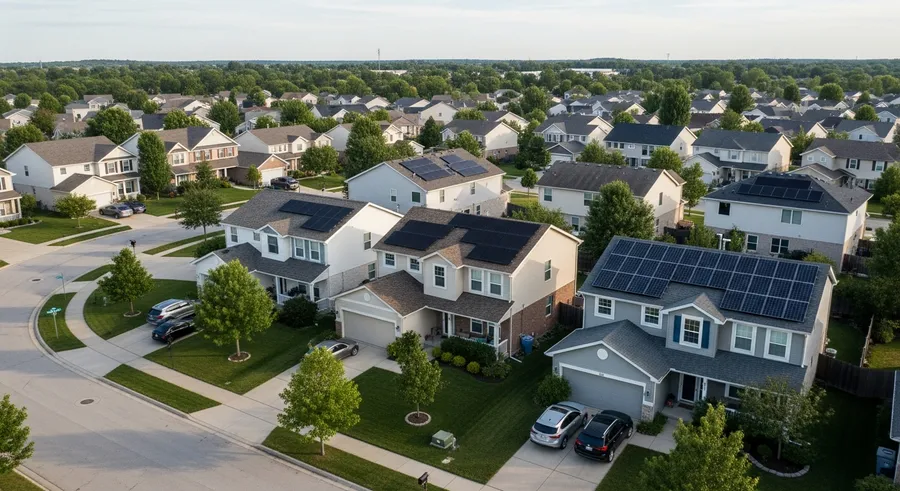
ComEd customers in Illinois still have a real solar case in 2026. The part that changed is the billing shortcut installers used for years. A pre-2025 residential solar system could often be modeled as if every kilowatt-hour had roughly the same value across the year. A new ComEd system cannot be modeled that way without overstating the result.
The reason is Smart Solar Billing. Effective January 1, 2025, ComEd moved new residential solar customers away from the older full-retail net-metering structure and into the export-credit framework approved through the Illinois Commerce Commission. The rider commonly referenced in ComEd material is Rider POGNM. It keeps solar valuable, but it separates two kinds of energy that older proposals sometimes treated as identical.
What changed after January 1, 2025
Under the older structure, a qualifying residential system with permission to operate before January 1, 2025 generally received one-for-one retail net metering. A kilowatt-hour exported during a sunny afternoon could offset a kilowatt-hour pulled from the grid later in the billing period at the full retail value, subject to the details of the customer rate class and utility bill.
That older structure matters because it is still real for grandfathered systems. A homeowner whose system received permission to operate before January 1, 2025 should not assume the post-2025 rules apply to that existing system. The grandfathering date is tied to permission to operate, not to when the panels were first quoted or when the contract was signed.
For new ComEd residential systems, the math is different. Solar production used inside the home as it is generated still offsets electricity at the delivered retail value. In ComEd territory, that all-in avoided value is commonly modeled near 16 cents per kWh, depending on the customer's rate, delivery charges, taxes, and rider mix. Solar production exported to the grid is credited at the applicable net export credit, not at the full delivered retail rate. For the standard ComEd supply period running through May 2026, the export-credit reference is 9.66 cents per kWh, consistent with the current price-to-compare period tracked by rate watchdogs such as the Citizens Utility Board.
Instant use is worth more than export
The practical rule is simple: a solar kilowatt-hour used in the house is worth more than a solar kilowatt-hour sent to the grid. The instant-use kilowatt-hour avoids the delivered retail charge. The exported kilowatt-hour earns the lower export credit.
That gap is not a reason to dismiss solar in ComEd territory. It is a reason to stop reading proposals that model every kilowatt-hour as if it had the same value. A Lake Zurich or Naperville home with daytime air-conditioning load, a pool pump, a heat-pump water heater, or daytime EV charging can still consume a large share of solar production at the higher retail value. A smaller household that empties out during the day may export a larger share of production and should see that lower-value export share in the payback model.
This is where Smart Solar Billing changes the installer conversation. The old question was often, "Can the roof support enough panels to offset annual usage?" The better 2026 question is, "How much of this production will the home use at the time it is generated?"
Why system sizing matters more now
Oversizing was easier to defend under one-for-one retail net metering. If the grid effectively banked exported energy at the retail rate, a system designed around annual usage could make sense even when production and household consumption happened at different times of day.
Under Smart Solar Billing, oversizing can still make sense for a high-load house, but the proof has to be in the hourly or monthly consumption pattern. A system that pushes a large summer surplus back to the grid at the export-credit rate may have a weaker return than a smaller system that captures most of its output inside the home.
The cleaner design target is not automatically 100 percent annual offset. It is the economic fit between roof production, daytime household load, and the export-credit treatment. For many ComEd customers, that means a moderate system with a high self-consumption share can beat a larger system with a lower blended value per kWh. For households planning an EV, a heat pump, or battery storage, the right system may be larger because future daytime load can absorb more production at the higher value.
What a ComEd quote should show
A useful 2026 ComEd quote should separate at least four assumptions.
- Instantaneous self-consumption. The proposal should estimate how much solar the home will use directly, not only annual system production.
- Net export credit. The proposal should state the assumed export-credit rate and identify whether it is using the current ComEd supply period, a tariff filing, or a generic state average.
- Grandfathering status. Existing system owners should verify permission-to-operate date before accepting any claim that the system moved onto Smart Solar Billing.
- Future load assumptions. EV charging, battery storage, and electrification plans should be explicit. They can materially change the self-consumption share.
A proposal that still describes post-2025 ComEd exports as "full retail net metering" is using stale language. A proposal that shows the bill disappearing without showing export math is also not enough. The right question is not whether solar works in Illinois. The right question is whether the quote is valuing each kilowatt-hour under the correct rule.
How incentives interact with the billing change
Illinois Shines Renewable Energy Credit payments are separate from Smart Solar Billing. The REC payment is an incentive tied to renewable generation and program eligibility, not a substitute for utility billing. Current block status and eligibility should be checked against DSIRE and the active Illinois Shines program materials before a proposal treats the REC value as guaranteed.
The federal Section 25D Residential Clean Energy Credit is not available for 2026 cash or loan installs. The IRS Residential Clean Energy Credit page states that the credit is not available for property placed in service after December 31, 2025, and the Public Law 119-21 FAQ confirms the cutoff. Section 48E can still matter for third-party-owned systems, but the credit belongs to the system owner, not to the homeowner signing a lease or power purchase agreement.
Questions to ask before signing
For a ComEd customer, the most useful installer questions are specific. What percentage of modeled production is consumed inside the home? What export-credit rate is used in the proposal? Is the export rate assumed to stay flat for 25 years? Does the model use actual interval data from the customer's meter, or a generic load shape? If the customer has an EV or battery plan, is that future load modeled or merely mentioned?
A careful installer can answer those questions without turning the conversation into a promise that the bill goes away. Smart Solar Billing did not make Illinois solar irrelevant. It made sloppy annual-offset math easier to spot.