
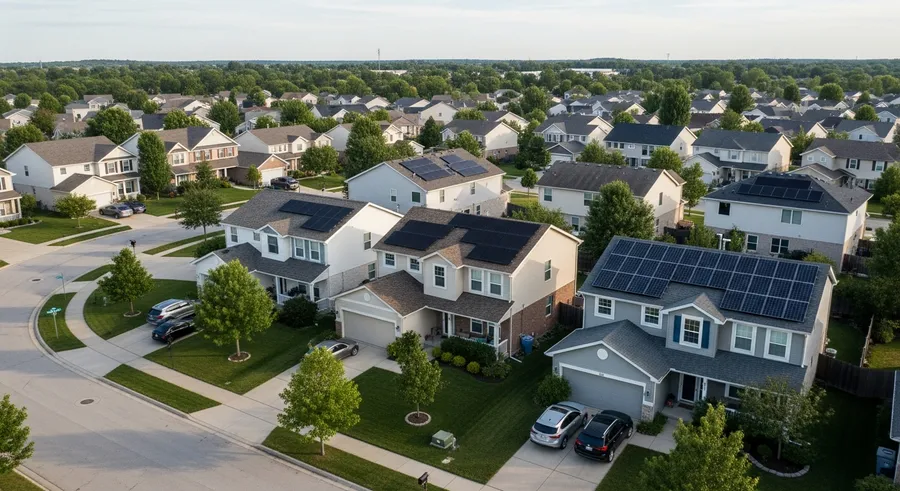
The short answer is yes, for the right house. The federal Residential Clean Energy Credit under Section 25D terminated for systems placed in service after December 31, 2025, under Public Law 119-21. That is a real change in the after-incentive cost of a residential install. It is not a change in how much electricity a roof produces, how fast retail rates are rising, or how long the equipment lasts. The math still pencils for the qualifying profile, and the diagnostic below lays out the inputs that actually move the answer.
What Public Law 119-21 actually changed
The Section 25D Residential Clean Energy Credit returned 30 percent of a homeowner's cash or financed installation cost as a nonrefundable federal income-tax credit. It applied to systems placed in service on or before December 31, 2025. The credit terminated on that date under Public Law 119-21. The Internal Revenue Service has confirmed the cutoff in its Residential Clean Energy Credit guidance and in a dedicated FAQ.
Section 48E, which is a different credit, remains in force. Section 48E applies to third-party-owned systems (power purchase agreements and solar leases), where the credit goes to the system owner, not the homeowner. For homeowners signing a PPA or lease in 2026, the installer captures the federal credit and passes a share of the value through in the contracted rate. For a cash purchase or a standard loan, there is no federal credit available in 2026.
State-level incentive programs continue independently of the federal change. Illinois Shines distributes Renewable Energy Credits to residential solar customers under the Climate and Equitable Jobs Act. Wisconsin Focus on Energy offers a rebate through August 31, 2026. Colorado Xcel customers continue to receive both standard net metering credits and the Solar*Rewards production payment. Oregon homeowners installing through an Energy Trust of Oregon Trade Ally receive a $2,500 upfront rebate plus a state property tax exemption under ORS 307.175, although the property tax exemption itself sunsets July 1, 2029.
The economic gap, in dollars
A typical 7 kW residential install in the Summit Energy Solutions four-state footprint prices at roughly $2.80 to $3.40 per watt all-in, per the National Renewable Energy Laboratory residential PV benchmark and the Lawrence Berkeley National Laboratory Tracking the Sun annual installed-price reporting. That is a gross install cost of $19,600 to $23,800. Under the pre-2026 Section 25D credit, a homeowner subtracted 30 percent of that figure from their federal income tax liability for the year of installation, for a credit value between $5,880 and $7,140.
That credit is what 2026 cash and loan installs no longer receive. Everything else about the install remains the same: production, panel and inverter life, racking warranty, the underlying utility export-credit mechanism, the state-level incentive stack. The math gets harder by the dollar value of the missing credit, not by anything physical.
Where the math still pencils
Solar continues to pencil cleanly in 2026 for the qualifying profile. The conditions that have always mattered, matter more now.
The math is sharpest when the following are true at the same time:
- Monthly electric bill consistently runs over $150. The offset value of a residential system scales linearly with usage. Above-average bills are where annual offset value compounds fastest, and they are the strongest single qualifier in 2026 just as they were in 2025.
- Roof faces roughly south, with minimal shading, and at least ten years of useful life remaining. A south-facing array at 20 degree tilt is the production sweet spot. East or west exposures trim production 10 to 20 percent. Heavy tree shade over even one panel of a string array cuts whole-string production sharply.
- Plan to stay in the home seven or more years. Cash payback in the four-state footprint typically lands around year seven to nine for the median qualifying install. Every year of ownership after payback is direct savings against the household bill, out to the 25 to 30 year practical life of the equipment.
- Cash purchase, HELOC, or a clean low-rate loan without dealer-fee markup. Dealer fees on solar loans are documented at 10 to 30 percent of contract price by the Consumer Financial Protection Bureau. A cash quote with no dealer fee is the real price of the system. Asking for the cash $/W alongside the financed quote is the fastest way to surface the markup.
For a homeowner who fits this profile, the cash payback math in 2026 lands roughly two to three years later than the same install in 2024 or 2025, because the missing 30 percent credit shifts the breakeven by that dollar amount. That is meaningful, but it is not catastrophic. A seven-year payback becomes a nine-year payback. A nine-year payback becomes an eleven-year payback. System life is unchanged.
State-by-state context
The state-level details drive a meaningful share of the final answer, and they differ by service territory.
Illinois. ComEd residential customers transitioned to Smart Solar Billing on January 1, 2025, under ICC-approved Rider POGNM. Self-consumed kilowatt-hours offset at the all-in delivered rate near 16 cents per kWh. Net exported kilowatt-hours credit at the supply rate, which is 9.66 cents per kWh through May 2026. Systems with permission to operate before January 1, 2025 remain grandfathered to retail-rate net metering. Illinois Shines REC payments stack on top of net metering. Naperville and a few other municipalities operate their own electric utilities with separate net-metering rules.
Wisconsin. We Energies credits self-consumed energy at the retail delivered rate but compensates net exports at an avoided-cost buy-back rate of 4.2 cents per kWh, materially below retail. Wisconsin solar economics depend on self-consumption and battery pairing more than on grid export. Focus on Energy provides a residential rebate through August 31, 2026.
Colorado. Xcel Energy credits residential exports at the full retail rate near 15 cents per kWh under standard net metering, and the Solar*Rewards program adds approximately 2 cents per kWh on every kilowatt-hour generated under a 20-year contract. Front Range solar resource is among the strongest in the country at this elevation. Verify against the most recent Xcel filing because Solar*Rewards has revised in prior program years. Cooperative customers (CORE Electric and others) are not regulated by the Colorado Public Utilities Commission and operate under separate member-board tariffs.
Oregon. Portland General Electric and Pacific Power customers installing through an Energy Trust of Oregon Trade Ally receive a $2,500 upfront rebate in the 2026 program year, plus a state property tax exemption under ORS 307.175. The property tax exemption sunsets July 1, 2029; systems installed after that date do not receive it, absent a legislative extension. Municipal utilities (Forest Grove Light and Power, Canby Utility Board) operate outside the ETO Trade Ally program and outside state PUC oversight.
What changed about how installers quote in 2026
Two patterns have emerged in the months since Section 25D terminated that homeowners should know about before signing.
Stale 30 percent credit line items on 2026 proposals. Some solar marketing sites and a smaller share of installer quotes were still publishing 30 percent federal credit numbers into 2026, despite the December 31, 2025 cutoff. A proposal that includes a 30 percent federal tax credit line item on a 2026 install is using stale numbers. That is grounds to ask the installer for a corrected proposal that reflects current law. The Internal Revenue Code Section 25D citation is the authoritative reference.
Dealer-fee markup pressure. With the federal credit removed from the after-incentive cost, the relative impact of dealer-fee markups on financed solar loans has grown. The CFPB documented dealer fees of 10 to 30 percent as common across the residential solar lending industry, and the absence of the federal credit makes those fees a larger fraction of total cost. Asking for the cash $/W on any financed quote is the fastest way to surface the markup before signing.
What does not change
Production modeling is unchanged. The NREL (renamed National Laboratory of the Rockies, December 2025) PVWatts v8 model uses the same National Solar Radiation Database irradiance data and the same equipment derate assumptions for a 2026 install as for a 2024 install. System life is unchanged at roughly 25 to 30 years. Panel and inverter warranties are unchanged. Interconnection rules and the technical requirements for net metering eligibility have not shifted at the federal level.
The single most common deceptive claim in residential solar, that the electric bill goes to zero after install, is documented by the Federal Trade Commission as deceptive on its face. A well-sized residential system offsets a meaningful share of consumption but leaves a residual bill for utility connection fees, peak hours when the array undersizes the home, and seasonal variation. That has always been true and remains true in 2026.
Bottom line
The Section 25D credit made the math easier. It did not make the math necessary. For homeowners with above-average bills, south-facing roofs, multi-year ownership horizons, and access to clean financing or cash, the residential solar economics in 2026 still favor installation by a comfortable margin. Cash payback typically lands at seven to twelve years across the Summit Energy Solutions footprint, with system life out to twenty-five years or more. The qualifying profile has narrowed slightly. The answer for that profile has not changed.
The diagnostic pages at Illinois, Wisconsin, Colorado, and Oregon walk the local utility rules, the worked-example payback range, and the incentive stack that applies after the federal credit gap. Every figure on those pages traces to a primary authority source documented on the methodology page.