
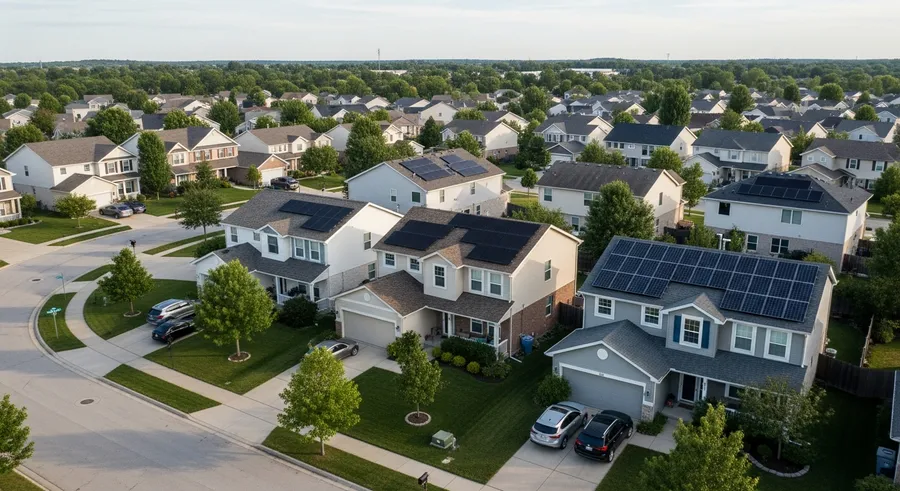
The short answer is yes, for the qualifying profile, and Colorado is one of the cleanest cash-payback markets in the four-state Summit footprint. Front Range solar physics are exceptional, Xcel Energy pays a production incentive on top of standard net metering, and the state property-tax treatment is favorable. The federal Section 25D credit expired December 31, 2025 under Public Law 119-21, so the after-incentive math in 2026 is materially different than in 2024 or 2025. The directional answer is unchanged for an above-average bill on a clear south-facing roof.
Why Colorado has unusually strong solar physics
The Front Range from Fort Collins through Denver to Pueblo sits at roughly 5,000 to 6,000 feet of elevation under one of the highest solar-irradiance bands in the continental United States. Thin air and predominantly clear skies translate into per-kilowatt production figures meaningfully above the regional averages.
A 7 kW south-facing residential array at 20 degree tilt, sited at typical Denver-metro coordinates, produces roughly 11,000 to 11,500 kilowatt-hours per year per the National Renewable Energy Laboratory (renamed National Laboratory of the Rockies by the U.S. Department of Energy in December 2025) PVWatts v8 model. That is a yield of approximately 1,570 to 1,640 kilowatt-hours per installed kilowatt. By comparison, the same array in northern Illinois yields about 1,300 to 1,340 kWh/kW, and in coastal Oregon roughly 1,140 to 1,180 kWh/kW. The physical envelope of available energy per dollar of installed system is meaningfully larger in Colorado than in the neighboring three states.
The practical implication is straightforward: at any given utility rate, a Colorado homeowner offsets more bill per dollar of system cost than a homeowner in a less sunny region. The Front Range physics alone shift the payback math by one to two years relative to similar bills in cloudier climates.
Xcel Energy compensation: net metering plus Solar*Rewards
Most Colorado residential customers are served by Xcel Energy (legally, Public Service Company of Colorado). Xcel residential solar compensation has two components that stack.
Standard net metering. Self-consumed kilowatt-hours offset the homeowner's bill at the full all-in delivered rate, near 15 cents per kWh as of the most recent published tariff. Exported kilowatt-hours that are not consumed at the home are credited at the same rate under monthly netting, with an annual true-up. This is materially more favorable than net-metering structures in some neighboring states (Wisconsin compensates exports at an avoided-cost rate of approximately 4.2 cents per kWh, well below retail).
Solar*Rewards production payment. On top of net metering credits, the Solar*Rewards program pays an additional incentive of approximately 2 cents per kilowatt-hour on every kWh generated by the system, under a 20-year contract. This payment applies to gross production, not net exports, which makes the economics of Colorado solar somewhat less sensitive to self-consumption strategy than they are in states without a production payment.
The Solar*Rewards incentive rate has declined from earlier program years and is subject to Colorado Public Utilities Commission approval as part of Xcel's Renewable Energy Standard compliance plan. Current rate and program availability should be confirmed against the active Xcel solar program page before treating any installer's payback math as final.
The 25D gap and what survives at the state level
The federal Residential Clean Energy Credit under Section 25D terminated for systems placed in service after December 31, 2025, under Public Law 119-21. For a 2026 cash or financed install at the typical Colorado price of $2.80 to $3.40 per watt, the missing 30 percent federal credit removes roughly $5,900 to $7,100 in after-incentive value compared with a 2025 install.
Colorado does not offer a state income tax credit for residential solar to replace the federal gap. The state-level economics rest on net metering plus Solar*Rewards plus property-tax treatment.
On property tax, Colorado residential solar electric generation facilities are exempt from property tax assessment under state statute. Unlike the Oregon residential property tax exemption (which sunsets July 1, 2029 under ORS 307.175), the Colorado exemption is not under a known sunset clause as of the most recent verification cycle. Specific provisions and any change to assessment treatment should be confirmed against current Colorado Department of Local Affairs guidance before signing a quote that prices the exemption into its assumptions.
Where the math pencils cleanest in Colorado
The qualifying profile for Colorado residential solar in 2026 is sharply defined.
- Above-average household electric bill, typically $120 per month or higher. Colorado retail rates run lower than some Midwestern states, so the per-kWh value of self-consumption is slightly smaller. The advantage in Colorado comes from production volume, not unit price, which means the math is most favorable when annual usage is high enough to fully consume the array.
- South-facing roof with clear exposure and at least ten years of useful life remaining. The 1,570 to 1,640 kWh/kW Front Range yield assumes south orientation and minimal shading. East or west drops production 10 to 20 percent. Heavy tree shade over even one panel of a string array cuts whole-string production sharply.
- Xcel service territory. Solar*Rewards applies only on Xcel; the layered production incentive does not exist for customers of cooperatives like CORE Electric or for municipal utilities. Service territory is the first verification before treating Solar*Rewards as part of the proposal.
- Cash purchase or clean low-rate loan without dealer-fee markup. The Consumer Financial Protection Bureau has documented dealer fees of 10 to 30 percent as common on residential solar loans. With the federal credit removed, those fees have a larger relative impact on total cost in 2026.
- Plan to stay seven or more years. Combined Xcel net metering and Solar*Rewards on the typical Front Range install land cash payback near seven to nine years for the qualifying profile. Every year of ownership after payback is direct savings.
Where the math gets trickier
Colorado is not uniformly favorable. Several categories of homeowner should run the diagnostic carefully.
CORE Electric Cooperative customers. CORE serves much of Douglas County (including Castle Rock and Parker) plus parts of Adams, Arapahoe, Elbert, Jefferson, Park, and Teller counties. CORE is member-owned, not regulated by the Colorado PUC, and operates a separate net-metering tariff set by its elected board. Xcel's Solar*Rewards program does not apply on CORE. Current CORE net-metering terms and any production-incentive payments should be verified directly against the latest CORE tariff before signing.
Mountain communities and high-shade properties. Solar resource is excellent at Front Range elevation, but localized terrain shade (canyons, dense conifer cover, north-aspect mountain slopes) cuts production materially. PVWatts at the specific ZIP and a site-specific shade analysis are the right inputs, not metro-wide averages.
Older homes with undersized electrical service. A solar interconnection on a 100-amp panel often triggers a service-panel upgrade before the install can pass inspection, typically adding $2,000 to $3,500 to the total project cost. This is not a Colorado-specific issue, but it surfaces frequently in older Denver-metro housing stock and should be priced into the gross install before evaluating payback.
How to verify a Colorado quote
Two cross-checks separate a clean Colorado solar quote from one running on stale or marketing-inflated numbers.
Confirm the federal credit is not on the line item. A 2026 quote that still shows a 30 percent federal tax credit reduction is using stale numbers and should be returned for a corrected proposal. Section 25D terminated December 31, 2025 under Public Law 119-21. The IRS guidance is explicit. Section 48E remains, but it applies to third-party-owned systems (PPAs and leases), where the credit flows to the system owner.
Cross-check Solar*Rewards against the current Xcel tariff. The Solar*Rewards incentive rate has declined from earlier years and is subject to CO PUC approval. A quote that prices the incentive into 20-year payback math should be against the current program rate, not against a prior year's higher number. The Colorado Public Utilities Commission docket page is the authoritative source for rate cases and approved tariffs.
Bottom line
Colorado residential solar economics in 2026 remain favorable for the qualifying Front Range profile. The combination of strong per-kilowatt production, Xcel's two-component compensation (net metering plus Solar*Rewards), and the state property-tax exemption stacks into one of the cleanest cash-payback markets in the four-state footprint, even with the Section 25D credit removed.
Cash payback for the qualifying Xcel-territory profile typically lands at seven to nine years. CORE Electric customers, mountain-community customers, and homeowners with older electrical service should run the numbers with their specific utility tariff and any service-panel cost folded in. The diagnostic walkthroughs at the Colorado state hub carry the utility record and the worked example, with figures traceable to primary authority sources documented on the methodology page.