
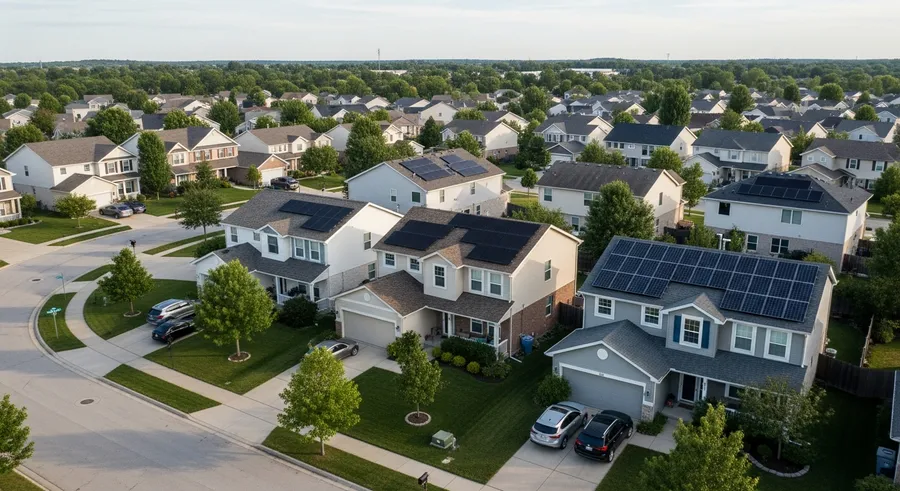
The short answer is yes, for the qualifying profile. Illinois residential solar economics in 2026 are shaped by two state-level transitions that matter more than the federal Section 25D expiration: the January 1, 2025 move from 1:1 retail-rate net metering to Smart Solar Billing for new ComEd customers, and the ongoing Illinois Shines REC program under the Climate and Equitable Jobs Act. Together with the federal credit gap, these reshape sizing strategy, sales-claim verification, and the basic payback math. The directional answer for an above-average bill on a clear south-facing roof remains favorable, though sharper than in pre-2025.
Smart Solar Billing: the January 1, 2025 transition
ComEd, the investor-owned utility serving most of northern Illinois and the Chicago metro, transitioned residential customers to Smart Solar Billing on January 1, 2025 under ICC-approved Rider POGNM. The change replaced the prior 1:1 retail-rate net metering arrangement for all new residential installations. Systems with permission to operate dated before January 1, 2025 remain grandfathered to the previous structure for the original term of their interconnection agreement.
Under Smart Solar Billing, the two flows of value are compensated differently:
Self-consumption (instantaneous offset): Kilowatt-hours produced and consumed at the home as they are generated offset electricity the household would otherwise have bought from ComEd at the all-in delivered rate. That rate currently sits near 16 cents per kWh and includes supply, delivery, transmission, taxes, and capacity charges.
Net export credit: Kilowatt-hours exported to the grid when the home is not consuming the production are credited at the supply rate only, not the all-in delivered rate. The current supply rate is 9.66 cents per kWh through May 2026, after which the rate resets following the next ComEd supply auction.
The economic implication is meaningful for sizing: a system sized so that most production is consumed on-site captures the full delivered-rate value on the majority of its output. A system sized well above the home's daytime load sends more to export and earns roughly 60 percent of the per-kilowatt-hour value on that share. This is not a Wisconsin-style avoided-cost crash (export credits in Illinois are still meaningful), but it changes the optimal sizing strategy.
Ameren Illinois, the IOU serving central and southern Illinois, transitioned to Rider NMOS for new residential solar customers on the same January 1, 2025 effective date under the Climate and Equitable Jobs Act. Post-2025 Ameren customers choose at application between kWh-netting (1:1 against supply, capacity, and transmission charges) or monetary credit at the current month supply rate. Ameren's 2026 Price to Compare ranges from 7.85 to 8.77 cents per kWh depending on usage tier.
Illinois Shines: the REC program that stacks on top
Illinois Shines is the statewide Renewable Energy Credit purchase program operated by the Illinois Power Agency under the Climate and Equitable Jobs Act of 2021. For residential solar, Illinois Shines purchases the Renewable Energy Credits associated with the system's electricity production for a multi-year contract term, paid as a single upfront lump sum at the time of installation.
The Illinois Shines REC value is meaningful: typical residential 7 kW installs receive between $4,000 and $7,000 in upfront REC payment, depending on the active program block and the system's specific size. This payment stacks on top of Smart Solar Billing (for ComEd customers) or Rider NMOS (for Ameren customers) and applies regardless of whether the system is grandfathered to old net metering or under the new tariff.
The program structure operates in blocks, with REC rates resetting between program years. Current block status and rates should be verified against the active Illinois Shines program page before signing a quote that prices the REC payment into its assumptions. The Illinois Power Agency publishes block transitions through the program's official channels.
The Section 25D federal gap
The federal Residential Clean Energy Credit under Section 25D terminated for systems placed in service after December 31, 2025, under Public Law 119-21. Illinois 2026 cash and financed installs do not receive the 30 percent federal credit. Section 48E remains for third-party-owned systems (PPAs and leases). Illinois has no state income tax credit equivalent.
One persistent marketing-myth deserves direct naming: there is no "Illinois 25 percent state solar tax credit." The Illinois Department of Revenue enumerates 76 individual income-tax credits, and zero are for residential solar or photovoltaics. The "25 percent IL state credit" claim that appears periodically in installer marketing material and on some solar comparison sites is a fabrication. Any quote that includes a 25 percent Illinois state credit line item is using a non-existent incentive. The authoritative reference is the Illinois Income Tax Act and the Department of Revenue's published credit list, both of which are publicly searchable.
Where the math pencils cleanest in Illinois
The qualifying profile for Illinois residential solar in 2026 is well-defined.
- Above-average bill, typically $150 per month or higher. The all-in delivered rate near 16 cents per kWh is meaningful, and Smart Solar Billing favors self-consumption. Above-average usage maximizes the share of production captured at the delivered rate rather than the supply rate.
- South-facing roof with clear exposure and at least ten years of useful life remaining. The 7 kW reference system at typical Chicago-metro coordinates produces roughly 9,150 to 9,400 kilowatt-hours per year per the National Renewable Energy Laboratory (renamed National Laboratory of the Rockies by DOE in December 2025) PVWatts v8 model.
- System sized closer to daytime baseload than to total annual usage. Under Smart Solar Billing, oversized systems lose value on the export-credit side. Sizing for self-consumption preserves the full delivered-rate offset on the majority of production.
- ComEd or Ameren service territory. Smart Solar Billing applies on ComEd; Rider NMOS applies on Ameren. Municipal utilities like Naperville Electric Utility operate under separate net-metering rules; verification runs through the city utility billing department.
- Cash purchase, HELOC, or clean low-rate loan without dealer-fee markup. The Consumer Financial Protection Bureau documented dealer fees of 10 to 30 percent as common on solar loans. The cash $/W on a clean quote is the real price of the system.
- Plan to stay seven or more years. Combined Smart Solar Billing plus Illinois Shines REC payment lands typical Illinois cash payback at seven to nine years for the qualifying profile on ComEd, with system life out to 25 to 30 years.
Where the math gets trickier
Naperville Electric Utility customers and other muni-utility homeowners. Naperville operates its own municipal electric utility rather than buying from ComEd. The April 2025 net-metering update for Naperville Electric credits on-site solar at retail rate against the electric utility component of the bill only, not against delivery, demand, or fixed meter charges. Excess generation banks monthly and cashes out annually each April at an avoided-cost rate near 4.9 cents per kWh. The narrower credit scope shifts cash-payback math toward nine to eleven years rather than the seven to eight typical of ComEd Smart Solar Billing.
Ameren downstate customers. The Ameren NMOS choice between kWh-netting and monetary credit at the supply rate makes a real difference depending on annual usage profile. A homeowner with heavy summer cooling and lighter winter heat may favor monetary credit; a homeowner with heavier shoulder-season usage may favor kWh-netting. The choice is made at application and is binding.
Older Chicago and suburban homes with shade-heavy lots. Mature street trees in older neighborhoods can cut production sharply. Site-specific shade analysis at the specific address is the right input, not metro-wide averages.
How to verify an Illinois quote
Three cross-checks separate a clean Illinois solar quote from one running on stale or fabricated numbers.
Confirm the federal credit is not on the line item. A 2026 quote that still shows 30 percent federal credit reduction is using stale numbers. Section 25D terminated December 31, 2025.
Confirm there is no "Illinois 25 percent state credit" line item. That credit does not exist and never has. The Illinois Department of Revenue's published list of income-tax credits is the authoritative source. Any quote that includes it should be returned for a corrected proposal.
Confirm the Illinois Shines REC payment against the current block. REC rates reset between program blocks. The current rate is published at the Illinois Shines program page. Quotes that assume a prior block's higher REC rate overstate the upfront incentive value.
Bottom line
Illinois residential solar economics in 2026 remain favorable for the qualifying profile, particularly on ComEd Smart Solar Billing with Illinois Shines RECs stacked on top. The January 2025 transition reshaped sizing strategy: smaller, self-consumption-optimized systems earn a meaningful premium over oversized export-heavy systems under the current export-credit rules. The federal credit gap is real and adds two to three years to typical payback, but the combination of Smart Solar Billing, Illinois Shines, and durable system life keeps the math comfortable for the qualifying profile.
Cash payback for the typical ComEd customer with above-average usage lands at seven to nine years; Ameren downstate customers see comparable or slightly tighter math depending on rider choice; Naperville Electric and other muni customers should run the diagnostic with their specific tariff. The walkthroughs at the Illinois state hub carry the utility record and the worked example, with figures traceable to primary authority sources documented on the methodology page.