
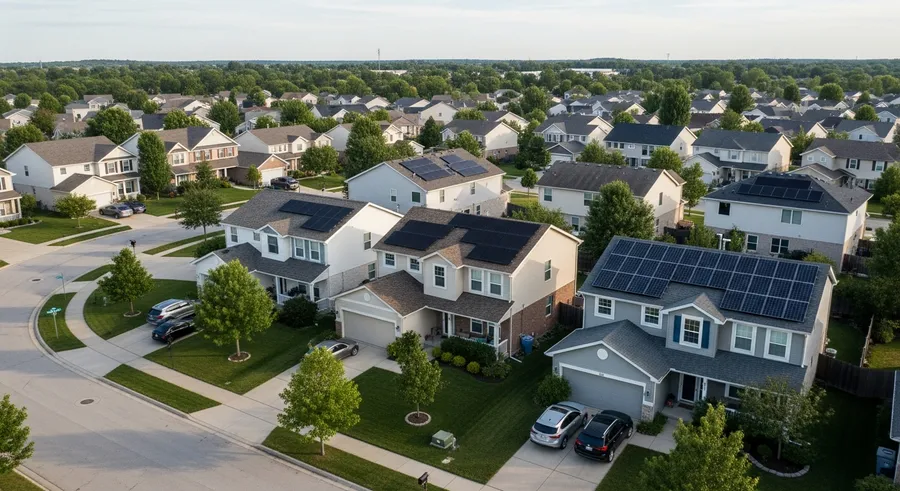
The short answer is yes, for the qualifying profile, with two caveats specific to Wisconsin that materially shape the math. We Energies pays an avoided-cost buy-back rate on net exports rather than the retail rate. The Focus on Energy rebate has a hard deadline of August 31, 2026. Both factors mean Wisconsin solar economics depend more on self-consumption discipline (and often on battery pairing) than they do in retail-net-metering states like Colorado or pre-2025 Illinois.
The avoided-cost compliance landmine
The single most important fact for any Wisconsin homeowner evaluating a solar quote is this: We Energies does not compensate net exported solar at the retail rate. Under the Customer-Owned Generation Buy-Back Rate (residential, for systems under 300 kW), self-consumed kilowatt-hours offset bill at the full all-in residential delivered rate, near 19 cents per kWh. But kilowatt-hours sent to the grid when the home is not consuming the production are compensated at an avoided-cost buy-back rate of approximately 4.2 cents per kWh as of the 2026 customer-generation rates filing.
That is a material asymmetry. A kilowatt-hour the home consumes as it is generated is worth roughly 4.5 times more than a kilowatt-hour exported to the grid. Any installer quote that quotes "net metering at retail" or assumes parity between self-consumption and export is using language that does not match the We Energies tariff. The buy-back rate is published in the Wisconsin Public Service Commission filing record and verifiable independently of any installer's claim.
The Public Service Commission of Wisconsin opened a value-of-solar literature review in September 2024 and has not revised the buy-back methodology pending Berkeley Lab study results. The current rate may change in future tariff cycles. Current terms should be verified against the latest PSC filing before treating any specific export rate as fixed.
Why this changes the math
In a retail-net-metering state, a homeowner can size a residential array to roughly match annual usage and treat the grid as a free battery: send excess in the day, pull credits at night. The math is straightforward.
In Wisconsin, that strategy leaves money on the table. Production exported during the day at 4.2 cents per kWh is worth materially less than production consumed instantaneously at 19 cents per kWh. The economic optimization is to maximize the share of production consumed at the home and minimize the share exported.
Two practical responses to this asymmetry show up in real Wisconsin installs:
Smaller array sizing. A homeowner with average daytime usage might size a system to match the daytime baseload rather than total annual consumption. The smaller array captures most of its production at the retail rate and exports less to the grid. The financial-return-per-installed-watt is higher even though total annual offset is lower.
Battery pairing. A residential battery (typically a Tesla Powerwall, Enphase IQ Battery, or Sonnen) stores midday solar production for evening household use at the retail rate. Battery pairing converts what would have been a 4.2-cent export into a 19-cent offset on the same kilowatt-hour, after accounting for storage round-trip losses (typically 8 to 12 percent). The economics of battery pairing are genuinely different in Wisconsin than they are in retail-NEM states; in Wisconsin, a battery has a non-trivial financial case beyond just backup power.
Focus on Energy: the August 31, 2026 deadline
Focus on Energy is Wisconsin's statewide energy-efficiency and renewable-energy program, funded by a small charge on utility bills and administered by a contractor under PSC oversight. For residential solar, Focus on Energy currently offers a rebate that meaningfully offsets gross install cost. Rebate amounts and structure can change between program years, and current terms should be verified directly with the Focus on Energy program before signing a quote that prices the rebate into its assumptions.
The hard deadline matters: the current Focus on Energy program year ends August 31, 2026. Systems installed and rebate applications submitted before that date qualify for the 2026 program rebate structure. Installs that complete after the cutover, even by a few days, fall under whatever rebate structure the PSC approves for the following program year, which may differ.
For homeowners weighing a 2026 install, the Focus on Energy deadline is a real timing constraint, not a marketing tactic. Permits, interconnection paperwork, and panel inspections take time. A reasonable timeline from contract signature to permission to operate is six to twelve weeks in southeastern Wisconsin, longer in peak season. Working backward from August 31, contracts signed after roughly mid-June carry meaningful schedule risk against the deadline.
The Section 25D gap
The federal Residential Clean Energy Credit under Section 25D terminated for systems placed in service after December 31, 2025, under Public Law 119-21. Wisconsin installs in 2026 do not receive the 30 percent federal credit on a cash or financed purchase. Section 48E remains, but it applies to third-party-owned systems (PPAs and leases), where the credit flows to the system owner, not the homeowner.
Wisconsin has no state income tax credit equivalent. The state-level economics rest on net metering (avoided-cost, as described above), Focus on Energy rebate (deadline-bound), and the homeowner's own consumption patterns.
Where the math pencils cleanest in Wisconsin
The qualifying profile for Wisconsin residential solar in 2026 is tighter than in retail-NEM states, but it is real.
- Above-average bill with a heavy daytime load. Wisconsin solar favors households that are home and consuming during the production day: retirees, work-from-home households, families with daytime energy users (pool pumps, EV charging on Level 1, daytime HVAC). A high-overnight-use household with low daytime base load is a harder fit because more production exports at 4.2 cents.
- Plan to add battery storage either at install or within five years. Battery pairing recovers most of the export-rate asymmetry by shifting evening usage onto stored solar. The economic case for a battery is genuinely different in Wisconsin than in retail-NEM states; treating the battery as part of the original system design (rather than a future add-on) is the cleaner approach.
- South-facing roof with clear exposure and at least ten years of useful life remaining. The 7 kW reference system at typical Wisconsin coordinates produces roughly 9,250 to 9,500 kilowatt-hours per year per the National Renewable Energy Laboratory (renamed National Laboratory of the Rockies by DOE in December 2025) PVWatts v8 model. East or west drops production 10 to 20 percent.
- Plan to stay nine or more years. Combined avoided-cost net metering and Focus on Energy rebate land typical Wisconsin cash payback at ten to thirteen years for the qualifying profile, longer than retail-NEM states. System life out to 25 to 30 years still leaves substantial savings runway after payback.
- Quote signed early enough to clear the Focus on Energy deadline. Mid-June is the practical cutoff for August 31, 2026 commissioning in most southeastern Wisconsin service territories. Later installs lose access to the current program-year rebate.
Where the math gets trickier
Households with a heavy evening-and-overnight usage profile. Without battery storage, evening usage cannot directly use solar production. Solar offsets the daytime portion of the bill but does not move the evening peak. The asymmetric export rate compounds this: production sent to the grid at 4.2 cents cannot be recovered later at the 19 cent retail rate.
Homeowners on muni utilities outside the We Energies/Focus on Energy framework. Wisconsin has a small number of municipal electric utilities (Madison Gas and Electric customers, Alliant Energy, We Energies suburbs vs city-owned utilities) with separate tariffs. The avoided-cost-vs-retail distinction described above is specific to We Energies. Madison Gas and Electric, Alliant, and other utilities operate under their own tariffs that should be verified separately.
How to verify a Wisconsin quote
Three cross-checks separate a clean Wisconsin solar quote from one running on stale or marketing-inflated numbers.
Confirm the federal credit is not on the line item. Section 25D terminated December 31, 2025. A 2026 quote that still shows 30 percent federal credit reduction is using stale numbers and should be returned.
Confirm the export-credit rate matches the actual tariff. Any quote for a We Energies customer that assumes retail-rate compensation on net exports is mathematically incorrect against the current Customer-Owned Generation Buy-Back Rate. The correct rate is approximately 4.2 cents per kWh, verifiable in the PSC docket. Either the quote uses the right number or the payback math is overstated.
Confirm the Focus on Energy rebate timing. The current program year ends August 31, 2026. A quote signed late summer 2026 should not assume the current rebate structure unless the installer can demonstrate the timeline clears the deadline. The Focus on Energy program-year cycle changes the rebate, sometimes meaningfully.
Bottom line
Wisconsin residential solar economics in 2026 favor a tighter qualifying profile than retail-net-metering states, but the math still pencils cleanly for the right house. The asymmetric We Energies export rate makes self-consumption (and often battery pairing) the central design question. The August 31, 2026 Focus on Energy rebate deadline is a real timing constraint that should anchor any 2026 install plan. Cash payback for the qualifying profile typically lands at ten to thirteen years, with system life out to 25 to 30. The diagnostic walkthroughs at the Wisconsin state hub carry the utility record and the worked example, with figures traceable to primary authority sources documented on the methodology page.