
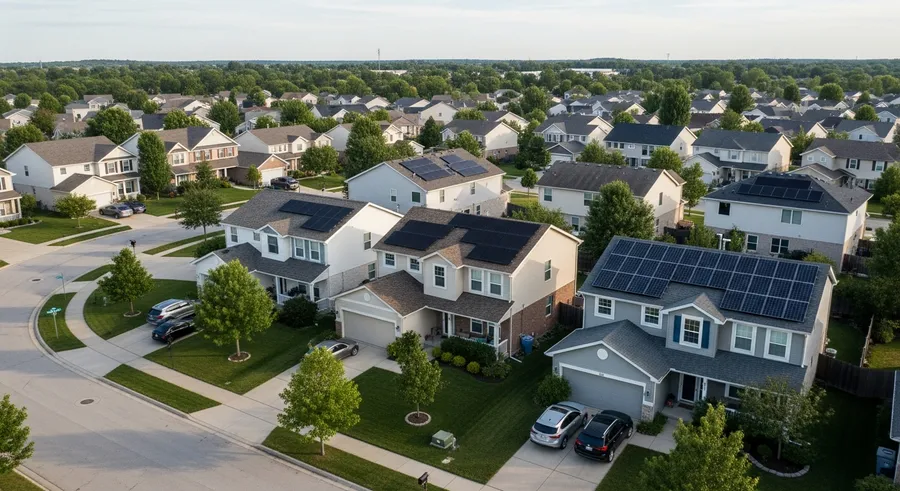
The "does solar add value when I sell my home" question has a more substantive answer in 2026 than the industry rule-of-thumb that gets quoted in sales meetings. Lawrence Berkeley National Laboratory has been tracking the home-sale premium for solar-equipped homes since 2011 across a multi-state dataset, and the published findings are the most defensible reference for what a residential solar install does to home resale value.
What the LBL data shows
The Berkeley Lab solar home pricing research has consistently documented a sales premium for owner-owned residential solar systems averaging in the range of $4 to $5 per watt of installed capacity, depending on the specific market and dataset year. For a 7 kW residential system, that translates to a sales premium in the range of $28,000 to $35,000 over comparable non-solar homes. The number varies by region (higher in California and the Northeast, lower in some Midwest markets), by buyer demographics, and by system age (newer systems carry higher premiums than 15-year-old systems).
The "4 percent home value premium" figure that is sometimes quoted in sales material derives from earlier LBL work and remains roughly directional, but the per-watt figure is the more defensible reference for a specific home with a specific system size.
Where ownership structure matters
The LBL premium applies to owner-owned systems (cash purchase or homeowner-financed loan). Third-party-owned systems (PPAs and solar leases) have a more complicated resale picture.
A buyer of a home with an assumable solar lease has to be willing to take on the contract for its remaining term, which can be 15 to 22 years on a typical 25-year lease originated 3 to 10 years before the sale. Many buyers are not, and some mortgage underwriters add friction. The seller's options are typically (1) find a buyer willing to assume the contract, (2) buy out the remaining lease term out-of-pocket before closing (typical buyout costs $10,000 to $25,000 depending on remaining term), or (3) accept a reduced sale price reflecting the buyer's discomfort with the contract.
The Berkeley Lab work generally finds that TPO systems do not produce a measurable sales premium and may produce a small discount in markets where buyer awareness of TPO contracts is high.
Where the federal credit change does not change the resale picture
The Section 25D federal Residential Clean Energy Credit expired December 31, 2025 under Public Law 119-21, but the resale value of an existing solar installation reflects the equipment, the production, the remaining warranty, and the avoided utility cost. None of those change with the federal incentive on new installs. A homeowner who installed solar in 2023 with the 30 percent federal credit still owns a 25-year asset with the same production profile and the same resale premium pattern. The 2026 expiration affects the math for new installs, not the resale value of installed systems.
One real implication of the federal change: replacement-cost calculations underlying the resale premium have shifted. A 2026 buyer pricing a comparable new system into their offer faces a higher gross install cost than a 2024 buyer would have, which arguably increases the marginal value of the existing system on the home being sold. This effect is small in absolute terms but directional.
What to ask before counting solar in resale plans
- Is the system owned outright? The resale premium applies to owner-owned systems. TPO contracts behave differently.
- What is the production guarantee status? Active monitoring data showing the system is meeting or exceeding modeled production strengthens the resale case. A system with no monitoring history or with documented underperformance does not carry the same premium.
- Are warranty documents available and transferable? A buyer's offer reflects what they can prove. Manufacturer warranties typically transfer with the home; workmanship warranties usually do too if the installer is still in business.
- What is the local appraiser experience with solar? Some markets have appraisers comfortable pricing solar; others default to ignoring it. The Appraisal Institute publishes solar appraisal guidance, but adoption varies. A pre-sale conversation with a local listing agent who has sold solar-equipped homes is worth more than a national average.
Bottom line
Owner-owned residential solar adds measurable value at home sale across LBL's multi-state dataset, with a documented per-watt premium that translates to roughly $28,000 to $35,000 on a typical 7 kW residential install. The premium is real, the premium is verifiable through public data, and the premium does not depend on the 2026 federal incentive picture. Third-party-owned systems behave differently and require careful handling in the sale process. Treating the resale premium as part of the long-term solar payback math is defensible; treating it as a guaranteed line-item return is not.