
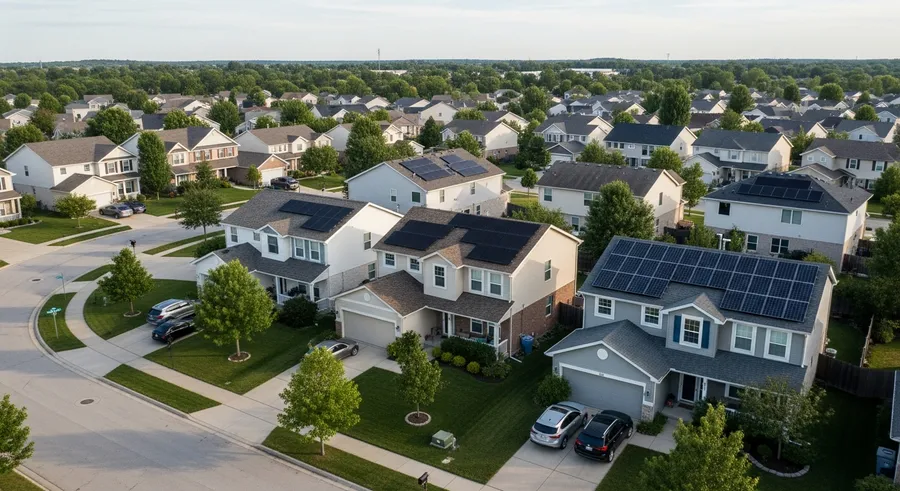
Solar is easiest when the person making the decision owns the roof, owns the meter account, and plans to stay in the home long enough to use the savings. Renters and non-roof owners do not have that clean setup. They can still participate in solar in some states, but the workable paths are different from a standard rooftop purchase.
The main options are community solar, landlord-approved rooftop solar, and in some cases a future purchase decision after homeownership. A rooftop PPA is usually not a renter solution because the contract needs roof control and long-term site permission.
Community solar is the main renter pathway
Community solar lets a customer subscribe to a share of a larger off-site solar project. The project produces electricity, the subscriber receives bill credits tied to the subscribed share, and the subscriber pays a subscription fee. The savings come from the spread between the bill credit and the fee, not from panels installed on the renter's roof.
This structure works for renters because it does not require roof ownership. The customer still needs an eligible utility account and should understand cancellation, transfer, term length, credit timing, and whether savings are guaranteed or merely estimated.
Illinois
Illinois has one of the more mature community solar markets in the Summit footprint. The state program is Illinois Shines Community Solar, part of the Adjustable Block Program administered for the Illinois Power Agency. Illinois Shines supports both distributed generation and community solar projects through Renewable Energy Credit contracts.
For a renter, the practical question is whether the community solar subscription applies to the same utility territory as the account. A ComEd customer subscribes to an eligible project and receives credits on the ComEd bill once the project is active. Subscription managers often advertise a percentage discount to the credit value. The customer should verify cancellation rules and whether the subscription can transfer after a move.
Colorado
Colorado's community solar framework is built around Community Solar Gardens under C.R.S. 40-2-127. The statute defines community solar gardens and the subscription structure, including bill credits against the subscriber's utility account. The Colorado PUC implements program rules for regulated utilities, and utility-specific availability changes over time.
Colorado is a good example of why program name and utility territory both matter. A Denver-area Xcel customer may see a different path than a customer served by a cooperative or municipal utility. The subscriber should check the Colorado Public Utilities Commission, the utility, and the subscription agreement before assuming a generic Colorado offer applies.
Oregon
Oregon has a formal Oregon Community Solar Program for eligible customers of Portland General Electric, Pacific Power, and Idaho Power. The program explains the basic structure plainly: subscribers receive a bill credit for their portion of generation and pay a subscription fee through the utility bill or program structure. The Oregon PUC oversees the program with the administrator.
Oregon also has a specific low-income participant structure where subscription fees must be below bill credits by a required margin. General-market savings are more variable.
Wisconsin
Wisconsin does not have a single statewide community solar program comparable to Illinois Shines or the Oregon Community Solar Program. Some utilities and cooperatives may offer renewable subscription products, shared solar projects, or green power options, but they are utility-specific. Wisconsin customers should check the serving utility, the Public Service Commission of Wisconsin, and DSIRE for current program availability.
This is where the distinction between community solar and a green-power plan matters. A green-power supply product may support renewable procurement without giving the customer a project-specific solar bill credit. A true community solar subscription should explain the project, allocation, bill credit, fee, and transfer or cancellation terms.
How subscription pricing works
Most community solar subscriptions create two bill effects. First, the customer receives a credit for the subscribed share of solar generation. Second, the customer pays a subscription fee to the project or subscription manager. The net savings is the credit minus the fee and any administrative charge.
That means a renter should not evaluate only the credit. A $40 monthly credit with a $36 subscription fee is a $4 gross monthly savings before any other charges. The contract should state how credits are calculated, how fees are calculated, what happens in low-production months, and whether excess credits carry forward.
Why rooftop PPA usually does not solve renting
A power purchase agreement places a solar system on a specific roof and gives a third-party owner the right to operate that system over a long contract term. That requires property-owner consent, interconnection authority, insurance coordination, and a long-term site agreement. A renter usually cannot grant those rights alone.
A landlord could sign a rooftop PPA for a rental property, but that becomes the landlord's property and utility decision. The renter might benefit if the lease passes through lower energy costs, but the renter is not the system owner and usually is not the PPA counterparty. If the renter pays the utility bill directly, the billing arrangement can become more complicated.
When waiting makes sense
For a renter planning to buy a home within the next year or two, waiting can be the cleaner financial decision. Rooftop solar depends on roof age, shade, meter account, utility tariff, property-tax treatment, and expected ownership horizon. Those inputs belong to the future house, not the current rental.
Community solar can still make sense during the rental period if the subscription is flexible, transferable, and clearly cheaper than the bill credit it produces.
The bottom line
Renters and non-roof owners should not be sold the same rooftop logic as a homeowner with a clean south-facing roof. The best available path is usually community solar where a real program exists, especially in Illinois, Colorado, and Oregon. Wisconsin is more utility-specific. Rooftop PPAs, leases, and purchases usually require property control that renters do not have. The right question is not whether solar is possible. It is which solar structure matches the customer's legal control of the roof and utility account.