
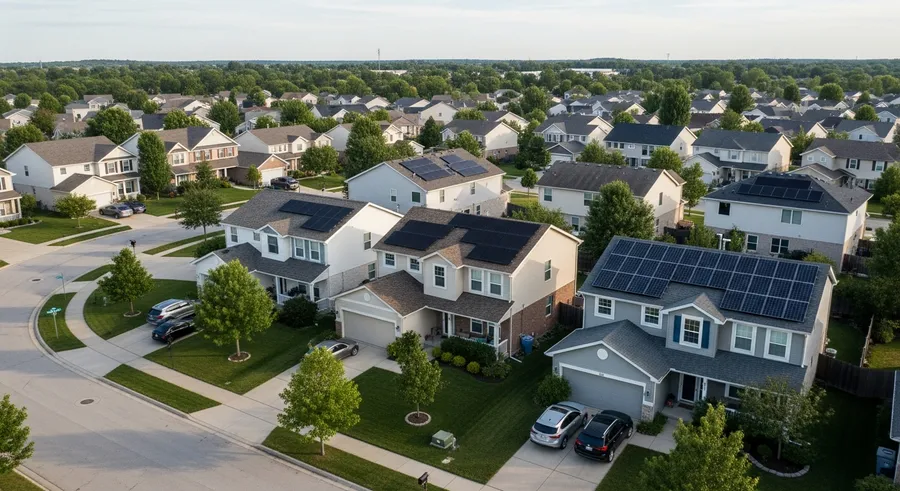
Homeowners associations can slow down a solar project, but in many states they cannot simply ban it. Illinois, Wisconsin, Colorado, and Oregon all have solar-access or solar-rights statutes that limit private restrictions on solar energy systems. Those laws are useful, but they are not blank permission to install any layout anywhere on a shared property.
The practical rule is this: state law usually protects the right to install, while the HOA may still regulate reasonable details such as placement, appearance, safety, common-area access, and architectural review procedure. A strong submission gives the association less room to delay and creates a record if the denial crosses the legal line.
Illinois
Illinois protects residential solar through the Homeowners' Energy Policy Statement Act, commonly cited as the Illinois Solar Rights Act. The core restriction appears in 765 ILCS 165/20, which limits deed restrictions, covenants, or similar agreements that prohibit or effectively prohibit solar energy systems on qualifying property subject to an association.
The Illinois law also allows associations to adopt energy policy statements and reasonable standards, so the review process still matters. An Illinois HOA may ask for an application, drawings, equipment details, location, and installation method. It should not use aesthetic review as a disguised ban or require a technology change that defeats the system economics.
Wisconsin
Wisconsin has two relevant pieces. Wis. Stat. 236.292 voids restrictions on platted land that prevent or unduly restrict the construction and operation of solar energy systems. Wis. Stat. 700.41 addresses solar and wind access, including damages for certain obstructions outside the applicable building envelope.
For an HOA dispute, 236.292 is usually the more direct citation because it speaks to restrictions that prevent or unduly restrict solar construction and operation. Section 700.41 is more about protecting solar access from later obstruction. Both should be verified against the current Wisconsin Legislature statute pages before a demand letter or legal filing.
Colorado
Colorado's main HOA-facing protection is C.R.S. 38-30-168, which makes covenants or restrictions that effectively prohibit or restrict renewable energy generation devices void and unenforceable, subject to reasonable aesthetic and safety limits. Colorado law also includes solar easement provisions in C.R.S. 38-32.5-101 and related sections.
Colorado is unusually specific about reasonableness. Aesthetic restrictions generally cannot increase cost or reduce performance beyond the statutory thresholds, and the review period is not supposed to become an indefinite holding pattern. Common-interest community rules may still require architectural review, especially where common elements or limited common elements are involved.
Oregon
Oregon's solar-access framework includes ORS 105.880 to 105.895. ORS 105.880 voids conveyance restrictions that prohibit use of solar energy systems, while ORS 105.885 to 105.895 define and govern solar energy easements and related access rights.
Oregon law does not mean every condominium roof, shared garage, or common-area structure is available for private equipment. Ownership and control of the surface still matter. A rooftop that is a general common element can require association approval even when the state disfavors solar bans on individually owned property.
What these laws protect
Solar-rights statutes protect against categorical bans and unreasonable restrictions. They are strongest when a homeowner owns the roof or lot where the system will sit, the system meets building and electrical code, the plan is professionally designed, and the requested layout is tied to real production value.
The laws are weaker when the project involves common areas, shared roofs, structural modifications outside the homeowner's control, unresolved roof maintenance obligations, or an application that lacks basic plan documents. A statute helps, but it does not replace a complete submission.
What an HOA can still regulate
An HOA can usually require architectural review, proof of permits, licensed contractor information, equipment specifications, conduit routing, roof attachment details, insurance certificates, and compliance with building and electrical codes. Associations can often regulate visible conduit, panel alignment, setback from roof edges, screening for ground-mounted equipment, and access to common areas.
The line is crossed when the association uses those rules to make the system impractical. A placement change that mildly adjusts appearance may be valid. A placement change that moves the array to a shaded roof face and materially reduces production is the kind of restriction solar-rights laws are designed to test.
The time-cost of review
HOA review can add two to six weeks to a project even when the law is favorable. The delay comes from monthly architectural review committee meetings, incomplete application forms, requests for neighbor notice, or a board that has not reviewed many solar projects. In a summer permitting season, that delay can push utility PTO into a later billing month.
The best way to reduce review time is to submit a complete ARC package on the first try. That usually includes the site plan, roof layout, equipment cut sheets, racking details, line diagram if available, contractor license and insurance, color or conduit notes if required, and a short cover note citing the applicable state law.
How to handle a denial
A denial should be requested in writing, with the specific covenant, rule, or design standard cited. A vague statement that solar is not allowed is not enough in the four-state Summit footprint. The homeowner should ask whether the association is denying the system outright, requesting a modification, or asking for additional documentation.
If the requested change reduces production, the installer should quantify the effect in kWh and percentage terms. That number matters in Illinois, Wisconsin, Colorado, and Oregon because the dispute is often about whether the association is regulating reasonably or effectively prohibiting the system.
The bottom line
State solar-rights laws give homeowners real leverage, especially against broad HOA bans. They do not eliminate the architectural review process. The best strategy is a complete ARC submission, a documented timeline, and a written response to any denial that ties the requested change to cost, production, safety, and the exact state statute. That keeps the dispute about the law and the design, not about personalities in a board meeting.