
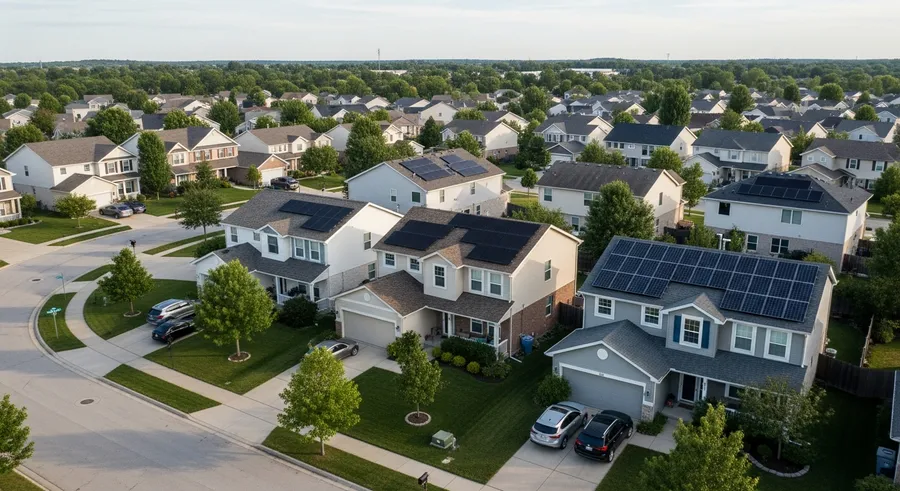
Solar panels are the most visible part of a residential solar install, but the inverter is the component that does the actual work of converting the panels' direct-current output into the alternating current the home and grid use. It is also the component most likely to need replacement during the system's life. The choice between a microinverter architecture and a string-inverter architecture is one of the more consequential decisions on a residential solar quote, and the trade-offs are not always presented clearly to homeowners at the quote stage.
How the two architectures actually differ
A string inverter is a single large device, typically wall-mounted near the electrical panel, that takes the direct-current output from the entire panel array as one input and converts it to alternating current. All panels in the array feed power into one inverter through one or more "strings" of panels wired in series. The most common manufacturers in 2026 residential markets include SolarEdge (with DC optimizers at each panel) and Tesla (with conventional string inverters). Pure string inverters without optimizers are still in use but less common on new residential installs.
A microinverter architecture places one small inverter at each panel. The conversion from DC to AC happens at the panel itself, and the panels feed alternating current into the home wiring directly. Enphase is the dominant residential microinverter manufacturer in 2026, with several smaller players in the market.
Where the practical differences show up
Shading and panel-level performance. A traditional string inverter with no optimization treats the entire string as a single unit. If one panel is shaded, the whole string's output drops to the level the shaded panel can sustain. Microinverters and string-inverter-with-optimizer architectures (SolarEdge pattern) avoid this by managing each panel independently. For a roof with no shading and uniform orientation, the difference is small. For a roof with partial shading from a chimney, dormer, or neighbor's tree, the panel-level architecture can capture meaningfully more energy across the year.
Monitoring depth. Microinverter and DC-optimizer systems report panel-level production data through their cloud monitoring portals. A homeowner can see which specific panels are underperforming. A pure string inverter without optimizers reports only string-level data, which makes it harder to diagnose a failing panel before it materially affects production. The monitoring depth matters most in years 5 to 15 of system life when panels start to show variation.
Failure profile. Both architectures have meaningful failure rates over a 25-year system life. A string inverter is one centralized device with typically a 10 to 15 year warranty; replacement is a single service call but a single point of failure for the entire system. A microinverter system has more devices (one per panel) but each is independent, and most carry 25-year warranties matching the panel warranty. The microinverter system has more parts that could fail but spreads the failure risk and rarely takes the whole system down at once.
Upfront cost. Microinverter systems typically run 5 to 15 percent higher in equipment cost than comparable string inverter systems. For a 7 kW residential install, that is roughly $800 to $2,500 of additional cost. The trade-off is real money.
What changed in 2026
The federal Section 25D Residential Clean Energy Credit expired December 31, 2025 under Public Law 119-21. Both architectures are unaffected by the change at the equipment level. The economic case for the more expensive architecture is now slightly weaker because the federal credit is no longer offsetting 30 percent of the upfront difference, but the production and reliability advantages remain unchanged.
What to ask the installer
- Which architecture are you quoting and why? A reputable installer should explain the choice in terms of the specific roof and the homeowner's monitoring preferences, not just default to whatever they have in stock.
- What is the monitoring subscription cost after year one? Some manufacturers bundle monitoring for the warranty period; others move to a paid subscription. Locked-out monitoring after the installer fails is a documented pattern.
- What is the inverter replacement cost in year 12? For string inverter systems, this is the single biggest mid-life expense. The installer should be able to estimate it on the proposal, not at the failure moment.
- If your company is no longer in business, who services the inverter under warranty? Manufacturer warranties typically pay parts but not labor. The installer-of-record handles the labor; a defunct installer leaves the homeowner paying labor on a warranty replacement.
Bottom line
Microinverter and string-with-optimizer architectures dominate the 2026 residential market for good reason: panel-level monitoring and shade tolerance capture real value. For roofs with clear southern exposure and no shading, a pure string inverter is still defensible at lower cost. For roofs with any meaningful shade pattern, the panel-level architecture pays back the cost premium through higher annual production. The right answer depends on the specific roof, and a quote that does not address the architecture choice is incomplete.