
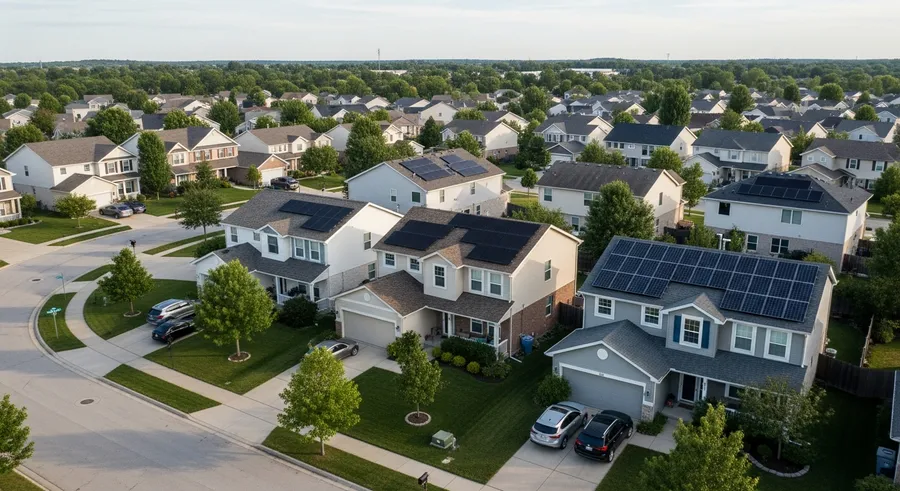
The default residential solar conversation starts with a single quote and a financed monthly payment. That conversation is incomplete. There are three distinct ways to pay for a residential solar install in 2026, and they produce different bills, different tax treatments, different ownership outcomes, and different long-term economics. The honest comparison asks the installer to quote all three for the same system specification and reads them side by side. Most installers can do this. The ones who cannot, or will not, are signaling that one specific deal structure works for them and the others do not.
Cash purchase
A cash purchase is the simplest deal structure: the homeowner pays the installer the full price of the system at install (or in agreed-upon milestone payments) and owns the system outright. The homeowner is responsible for any system maintenance, monitoring subscription, and warranty coordination. The installer is responsible for installation workmanship and ties to the manufacturer warranties on equipment.
The 2026 federal incentive picture for cash purchases is the cleanest of the three: there is no homeowner-claimed federal tax credit. The Section 25D Residential Clean Energy Credit terminated for systems placed in service after December 31, 2025 under Public Law 119-21. State and utility incentives still apply: Illinois Shines REC payments, Wisconsin Focus on Energy rebates through August 31, 2026, Colorado Solar*Rewards production payments, Oregon Energy Trust Trade Ally rebates, and other state-level programs route differently in each market.
The economic case for cash is that the system costs less in total dollars over its lifetime than the same system financed (no interest, no dealer fees) and the payback math is the cleanest to verify. The constraint is that the homeowner needs the capital or the home equity to commit. A HELOC against the home is structurally a cash purchase for the solar transaction (the loan is between the homeowner and the bank, not between the homeowner and the installer), and produces the same incentive treatment.
Solar loan
A solar loan is a third-party financing arrangement, typically arranged through the installer. The homeowner owns the system but pays for it over time through monthly loan payments. The same 2026 federal incentive treatment applies as the cash case: no homeowner-claimed Section 25D credit, state and utility incentives apply per state.
The complication on solar loans in 2026 is the dealer fee. The Consumer Financial Protection Bureau documented in its August 2024 issue spotlight on residential solar financing that dealer fees of 10 to 30 percent of the contract price are common in the industry, with some exceeding 50 percent. The dealer fee is the difference between the cash price of the system and the financed-deal price; it pays the financing company for offering a low advertised interest rate, and it gets bundled into the financed principal.
The single most useful comparison at the quote stage is the cash $/W next to the financed $/W. If they differ materially, the difference is the dealer fee, not the interest. A quote that lists a 1.99 percent APR and a financed price 15 percent above the cash price is offering financing at an effective interest rate much higher than 1.99 percent once the dealer fee is amortized into the cost. A clean loan quote will show both prices without pressure, and the dealer-fee gap will be modest or zero.
Third-party-owned: lease or PPA
A solar lease or power purchase agreement (PPA) is a structurally different deal. The homeowner does not own the system. A third party (typically a solar developer or finance company) owns the system, installs it on the roof, and either charges the homeowner a fixed monthly lease payment (lease) or charges per kilowatt-hour produced (PPA). The homeowner agrees to host the system on the roof for a contract term (typically 20 to 25 years).
The 2026 federal incentive treatment is materially different for TPO deals. Section 48E (the commercial clean electricity credit) remains in force for third-party-owned systems. The credit flows to the system owner, not the homeowner. The system owner factors the value of the credit into the lease rate or PPA price; the homeowner sees the benefit indirectly through a lower contracted payment. The homeowner does not claim any federal credit personally.
The trade-off on TPO deals is straightforward: lower upfront cost (often zero) in exchange for not owning the system, not capturing future utility-rate-escalation savings as cleanly, and accepting transferability complications at home sale. A lease or PPA can complicate selling the home because the buyer either has to assume the contract or the seller has to buy out the remaining lease term. Title companies and mortgage lenders increasingly expect TPO contracts to be disclosed early in the sale process, and some buyers walk away from homes with assumable solar leases they did not want.
The side-by-side comparison the installer should provide
A complete quote at the same system specification (panels, inverter, racking, target production) priced three ways gives the homeowner an apples-to-apples view of the trade-off.
- Total cost over 25 years. Sum of monthly payments plus down payment for loan and lease, plus expected utility bill after solar offset. Cash purchase produces the lowest 25-year total in almost every case where the homeowner can commit the capital.
- Monthly cash-flow impact in year one. Cash purchase has the largest one-time outlay; loan and lease have monthly payments that should be measurably lower than the displaced utility bill. A monthly payment higher than the bill it is supposed to replace is a deal that does not pencil regardless of how it is presented.
- Ownership and home-sale implications. Cash and loan: homeowner owns the system, system improves home value (the Lawrence Berkeley National Laboratory solar home pricing research tracks this directly). Lease and PPA: contract assignment at sale, possible buyer pushback.
- Federal incentive treatment. Cash and loan: no homeowner federal credit in 2026. Lease and PPA: system owner claims Section 48E, value flows through in the contract economics.
What to verify on each structure
Cash: milestone payment schedule, what each milestone triggers, refund policy if installation cannot complete (roof issue, interconnection delay, permit denial).
Loan: cash $/W next to financed $/W (the dealer-fee disclosure), APR, term length, UCC-1 lien language (lien on the system equipment is manageable; lien on the property is materially harder to clear at sale), prepayment penalty terms.
Lease or PPA: escalator clause (most contracts have an annual rate escalation, typically 1.5 to 3 percent), assignment language for home sale, buyout schedule, performance guarantee, end-of-term disposition (does the system stay, does it get removed, can the homeowner buy it out for fair market value).
Bottom line
Three deal structures, three different math problems, three different ownership outcomes. The right comparison reads all three side by side at the quote stage, against the same system specification. Each has a use case where it pencils best: cash for households with the capital and a stay-put horizon, loan for households comfortable with the dealer-fee math being transparent, lease or PPA for households who value zero upfront cost and accept the trade-off on long-term ownership economics. The honest installer can quote all three; the one who can only quote one is selling a deal that works for them, not necessarily for the buyer.