
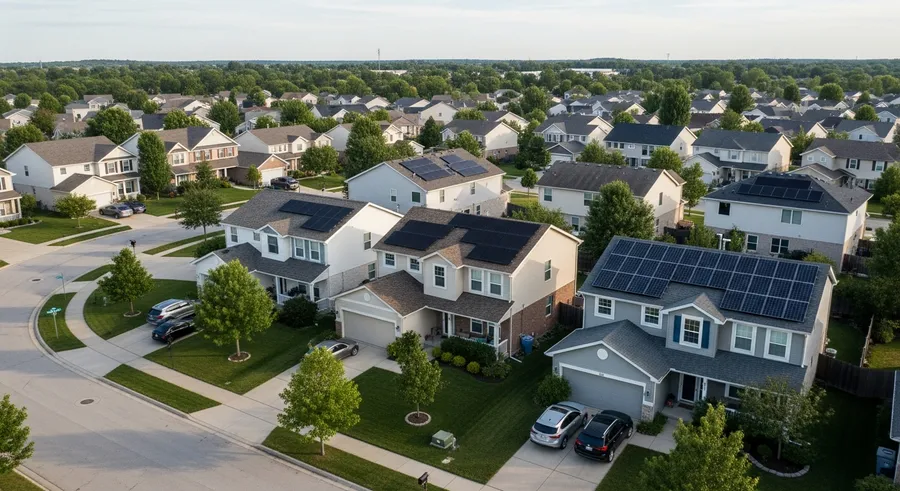
The marketing pitch for residential solar often includes the phrase "no maintenance required." That overstates the case. A modern residential solar system requires less maintenance than most major home systems, but the actual long-run cost is not zero, and the difference between a low-maintenance install and a high-maintenance one is usually traceable to decisions made at the install stage. Understanding what the system actually needs is part of the pre-purchase due diligence.
What the system actually needs in normal operation
Annual visual inspection. Either by the homeowner or by an installer service contract. A walk-around (or roof inspection) once a year confirms that no panels are visibly damaged, no flashing has lifted, no critter has built a nest under the array, and no wiring is exposed. Most issues that develop are visible from the ground or roof edge.
Periodic cleaning, climate-dependent. Residential solar panels are designed to be self-cleaning under normal precipitation. In climates with regular rain (the Pacific Northwest, the Midwest, the Northeast), panels typically need no scheduled cleaning. In dust-prone or pollen-heavy climates with extended dry periods, performance can degrade by 5 to 15 percent until the next major rain. Households in those climates may benefit from one annual professional cleaning, typically $150 to $400 depending on roof access and array size.
Monitoring portal review. A homeowner with cloud monitoring access should glance at the dashboard monthly during the first year (to establish a normal production pattern) and quarterly thereafter. Monitoring catches inverter faults, panel underperformance, and connectivity issues before they cost real money.
Squirrel and bird protection. Critters can nest under raised panels. Wildlife mesh (sometimes called "critter guard") around the panel perimeter is a one-time install of $300 to $700 that prevents most nesting. Many installers will include it as an option; some will not mention it. Asking is appropriate.
What needs replacement at predictable intervals
Inverter, year 10 to 15 (string architecture). A string inverter typically carries a 10 to 15 year warranty and may need replacement once during the system's 25-year life. Replacement cost in 2026 is roughly $1,500 to $3,500 for a typical residential string inverter, parts plus labor. Microinverter systems typically have 25-year warranties on each microinverter and are more likely to see scattered individual failures rather than a single mid-life replacement.
Critter mesh, year 8 to 15. If installed, mesh corrodes or wears out and may need replacement once during system life.
Roof underneath the array. Solar arrays are designed to outlast the typical asphalt-shingle roof they are mounted on. A roof installed at the same time as the panels typically reaches the end of its warranty life around year 20 to 25, at the same time as the panels begin showing meaningful degradation. The homeowner faces a removal-and-reinstall cost (roughly $1,500 to $3,000 on simple jobs) when the roof needs replacement, plus the cost of the new roof itself.
What goes wrong on poorly installed systems
Maintenance cost stays low when the install was done well. A few patterns drive most of the post-install issues, and each is preventable at the quote stage.
Inadequate roof penetration sealing. Each mounting bracket goes through the roof and must be sealed. Poor sealing leaks years later, sometimes triggering the homeowner's roof warranty exclusion (most roof warranties exclude penetrations not made by the original roofer). The fix is roof flashing repair plus possibly localized roof replacement, $500 to $3,000.
Loose racking or fastener failures. Improperly torqued fasteners can loosen over years of thermal cycling. Field reports of arrays that have lifted partially during high winds usually trace to under-spec fastener or rail attachment.
Connector arc faults. The DC connectors at each panel are a known failure mode. A bad connector can heat, char, and in rare cases ignite. Modern arc-fault circuit interrupters detect and shut down on arc fault, but the connector still needs replacement. Annual visual inspection catches early signs.
Defunct installer monitoring lock-out. When the installer goes out of business, the homeowner sometimes loses access to the cloud monitoring portal because the account was registered to the installer rather than the homeowner. The fix is contacting the inverter or microinverter manufacturer directly to claim ownership of the system; this works for major brands but takes time.
Total predictable maintenance cost over 25 years
For a typical residential solar install in good condition, the cumulative maintenance and replacement cost over a 25-year system life lands roughly in the range of $3,000 to $7,000. Most of that is one inverter replacement and one or two cleanings or critter-protection installs. Spread over 25 years, that is roughly $120 to $280 per year, or about 0.5 to 1.5 percent of the original install cost annually. By comparison, the same household's electric bill without solar over 25 years would total tens of thousands of dollars more.
What to verify before signing
- Workmanship warranty length and what it covers. Should explicitly cover roof penetrations and racking attachment for at least 10 years. The shorter the warranty, the more risk the homeowner carries on install-quality issues.
- Cloud monitoring access registered to the homeowner. The homeowner should receive monitoring login credentials at install completion, with the account registered to the homeowner email rather than the installer's.
- Wildlife mesh option pricing. Should be a clear line item on the proposal or a documented "not included" item the homeowner is opting out of.
- Inverter warranty length and post-warranty replacement cost estimate. A reputable installer can put a number on year-12 inverter replacement.
- Service area continuity. Whether the installer maintains a local service crew or routes warranty calls to a corporate dispatch. Local crews respond faster.
Bottom line
Residential solar is genuinely low-maintenance compared to most major home systems, but it is not zero-maintenance. Predictable annual costs are small. Mid-life inverter replacement is the largest single expense for string-inverter systems. The patterns that drive expensive post-install problems (sealing, fasteners, connector quality, monitoring lock-out) all trace to install-quality decisions made at the quote stage, which is where the protection lives.