
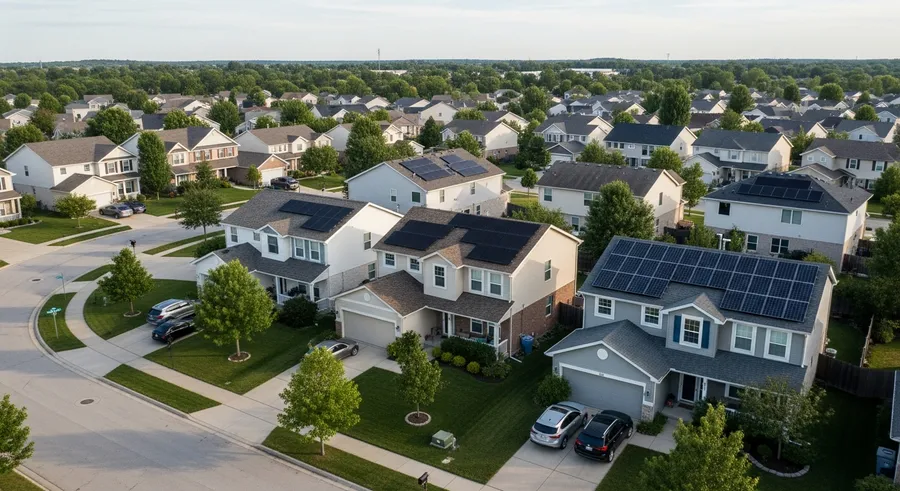
The expiration of the Section 25D Residential Clean Energy Credit should have made solar sales conversations more precise. It did not always do that. The IRS Residential Clean Energy Credit guidance and Public Law 119-21 FAQ confirm the homeowner credit is not available for systems placed in service after December 31, 2025, but several older claims still show up in 2026 proposals.
The problem is not that solar stopped working. Solar still pencils for the right house. The problem is that old shortcuts survived into a market where the margin for sloppy assumptions is smaller.
Myth 1: Solar pays for itself in five years
A five-year payback was possible in some earlier markets: high electric rates, strong state incentives, the now-expired 30 percent federal credit, clean roof exposure, and a cash purchase without financing markup. Treating five years as the normal 2026 payback is not defensible.
The better benchmark is state and utility specific. In the Summit footprint, qualifying cash projects often land closer to seven to twelve years depending on system cost, production, export-credit treatment, state incentives, and ownership horizon. Lawrence Berkeley National Laboratory's Tracking the Sun project is the right kind of source for installed-price context because it tracks real distributed solar pricing rather than sales-deck assumptions.
A proposal that advertises five-year payback should show every input: gross cash price, incentives, annual production, self-consumption share, export credit, utility-rate escalation, degradation, financing cost, and maintenance assumptions. Without those inputs, the payback claim is marketing, not analysis.
Myth 2: All solar exports get the same credit
Export value is one of the largest differences between state markets. A retail-net-metering structure credits exported solar close to the value of electricity consumed from the grid. An avoided-cost structure credits exports closer to the utility's marginal cost. A supply-rate structure lands somewhere between those poles. Those are not small differences.
Illinois ComEd customers with permission to operate before January 1, 2025 remain grandfathered under the older retail structure. New ComEd systems fall under Smart Solar Billing through ICC Rider POGNM, where net exports are not valued the same as self-consumed solar. Wisconsin avoided-cost territories can create a still wider gap. Colorado and Oregon investor-owned utility customers may see more favorable retail-net-metering treatment, subject to current tariffs.
The verification path should run through the relevant commission or utility source: ICC, PSC Wisconsin, Colorado PUC, and Oregon PUC. A national article cannot substitute for the tariff that governs the meter.
Myth 3: The system pays for itself before the house is sold
This claim depends entirely on ownership horizon. A cash system with an eight-year payback can make excellent sense for a homeowner planning to stay fifteen years. The same system may be a weaker fit for a homeowner expecting to sell in three years, especially if the sale happens before the buyer fully values the system.
Financing structure matters too. A paid-off owned system is simpler at resale than a system with a loan, lease, or power purchase agreement. A UCC-1 filing on equipment can create title questions even when it is not a mortgage lien. A lease or PPA can require buyer assumption or seller buyout.
Lawrence Berkeley National Laboratory's solar home pricing research supports the idea that owned solar can add value, but it does not turn every system into a guaranteed pre-sale payoff. Market, system ownership, age, buyer awareness, utility rates, and contract terms all matter.
Myth 4: Production guarantees protect the homeowner
Production guarantees can be useful. They are not the same as a perfect shield against underperformance. The first question is whether the proposal uses a P50 or P90 production estimate. A P50 estimate is a midpoint expectation. Actual annual production can land above or below it. A P90 estimate is more conservative and is usually the stronger number for financial planning.
The second question is the remedy. If production misses the guarantee, does the contract pay cash, extend a term, send a technician, or merely review the system? What exclusions apply for weather, shade growth, soiling, homeowner internet outages, utility outages, equipment downtime, or delayed PTO? A guarantee with broad exclusions may protect less than the headline suggests.
Production models should be anchored to a transparent source such as NREL PVWatts, with roof orientation, tilt, shade, and degradation assumptions visible. The guarantee is only as good as the model and the contract remedy.
Myth 5: Solar increases home value by 4 percent, guaranteed
Solar can increase home value, especially when the system is owned, permitted, operating, and easy for the buyer to understand. The mistake is turning that into a guaranteed percentage. The often repeated 4 percent idea does not function as a promise for every house.
LBL's solar home pricing work found premiums in studied markets, but the results vary by location, system size, system age, ownership structure, local electricity rates, and buyer expectations. A newer owned system in a high-rate market is not the same as an older leased system with escalator clauses. A buyer who wants solar is not the same as a buyer worried about roof age or contract transfer.
The safer resale claim is narrower: owned solar may add value when the system is properly documented and the buyer understands the utility savings. The contract should preserve the documents that support that claim: permits, PTO, final invoice, production history, warranty records, and any loan payoff or UCC release.
Bottom line
Public Law 119-21 did not end residential solar economics. It ended one federal homeowner credit and made the remaining assumptions easier to audit. Five-year payback, equal export credits, guaranteed pre-sale payoff, blanket production protection, and fixed home-value premiums are all too broad for 2026. The stronger solar case is narrower and better supported: right-sized system, correct utility tariff, clean financing, transparent production model, and a homeowner who stays long enough for the savings to matter.