
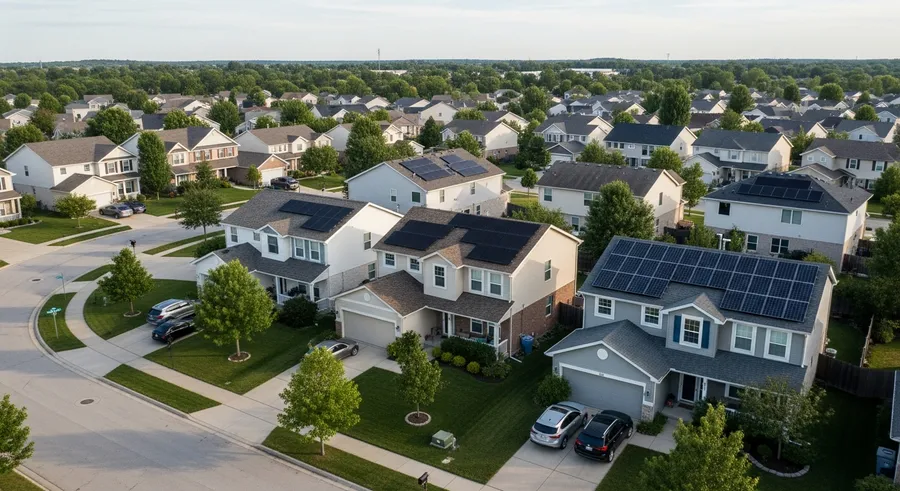
Residential solar sizing is often described as a question of bill offset: 70 percent, 90 percent, or 100 percent. That framing is too crude for 2026. A sizing model starts with annual kilowatt-hour usage, roof production potential, future load, and the local export-credit rule. The target is not a slogan. It is a production number that should match the household and utility tariff.
The common installer workflow is straightforward. First, the installer reviews the last 12 months of electric usage. Second, the designer estimates annual solar production for the usable roof planes, usually with a model such as NREL PVWatts or a design platform built on similar weather and irradiance inputs. Third, the proposal chooses a target offset and maps it to panel count, inverter capacity, and expected utility bill impact.
Why percent of bill is the wrong question
A utility bill is a dollar outcome. A solar system produces kilowatt-hours. The conversion between the two depends on delivery charges, fixed charges, taxes, rate design, time of use, and export-credit treatment. A system that offsets 90 percent of annual kWh may offset less than 90 percent of the bill if exported energy earns less than retail. A system that offsets 70 percent of annual kWh may offset a larger share of the bill if most production is consumed inside the home during high-value hours.
The better question is: what production target creates the best lifetime value for this household under this utility rule? That forces the proposal to separate self-consumed solar from exported solar and account for future load.
The production-target method
For a typical owner-occupied home with stable usage, installers often target 90 to 100 percent of historical annual consumption. A home that used 10,000 kWh last year might receive a design expected to produce 9,000 to 10,000 kWh in year one. In a retail-net-metering market, that can be a clean design because exported daytime production and imported evening electricity receive similar bill treatment.
That target shifts when the homeowner expects an EV, heat pump, induction range, heat-pump water heater, pool pump, or finished basement. A household moving from 10,000 kWh to 14,000 kWh over the next two years should not size only to the current bill if the roof can support the future load. Adding panels later is usually more expensive per watt because the second project repeats permitting, interconnection, and mobilization costs.
The target also shifts down when exports are credited below retail. In those markets, a 100 percent annual offset can create too much low-value export. The more conservative design may produce less energy overall but capture a higher value per kilowatt-hour.
Three sizing modes
Under-size for small bills. A small-bill household often should not chase full offset. Fixed charges remain after solar, and small systems carry soft costs that do not shrink perfectly with panel count. A 4 kW system may cost more per watt than an 8 kW system because permitting, design, truck rolls, and interconnection work are similar. For a household with low usage and no electrification plan, a smaller array on the best roof plane can be more defensible than filling the roof.
Full-offset for typical bills. A home with moderate to high usage, good southern or western exposure, and a stable occupancy pattern is the classic full-offset case. In Colorado Xcel territory and Oregon investor-owned utility territory, retail-net-metering treatment makes a 90 to 100 percent annual target easier to defend because exported kWh retain strong value. Current utility rules should still be checked through the Colorado Public Utilities Commission or the Oregon Public Utility Commission.
Over-size for EV or heat-pump trajectory. A household planning an electric vehicle or major electrification may reasonably size above the last 12 months of usage. The proposal should show the math: projected miles, kWh per mile at the wall, expected charging time, and any heat-pump load assumptions. Oversizing is strongest when future load is real and near-term, not merely a vague possibility.
How export-credit markets push size down
Smart Solar Billing and avoided-cost markets change the optimal design. Illinois ComEd customers who received permission to operate before January 1, 2025 remain grandfathered under the older retail-net-metering structure. New ComEd systems after that date fall under ICC-approved Rider POGNM Smart Solar Billing, where self-consumed solar is worth more than net exports. Wisconsin avoided-cost treatment creates an even larger gap between self-consumption and export value in some territories.
In those markets, the best system may be smaller than the roof maximum. A 7 kW system with a high self-consumption share can outperform a 10 kW system that exports a large midday surplus at a lower credit. The installer should model the blended value per kWh, not only annual production.
Batteries and load shifting can move the answer back upward. If daytime exports can be stored for evening use, or if an EV can charge during solar hours, a larger array may recover value that would otherwise be lost to low export credit. The sizing model should make that assumption explicit.
Sample four-state patterns
Illinois. Post-2025 ComEd sizing should usually start with daytime load and realistic self-consumption, then expand for EVs, heat pumps, or storage. Full annual offset can still pencil, but only if the export share is valued under Smart Solar Billing. ICC material is the state-level reference point for tariff verification at icc.illinois.gov.
Wisconsin. Avoided-cost export treatment pushes the design toward smaller arrays, higher self-consumption, or battery pairing. The Focus on Energy residential solar deadline of August 31, 2026 affects timing, but it does not justify oversizing on its own. Program status should be cross-checked through DSIRE and state utility records.
Colorado. Strong Front Range production and retail-net-metering treatment can support 90 to 100 percent annual offset for the right Xcel-served home. Colorado production per installed kW is often higher than in the Midwest, so the same annual target may require fewer panels.
Oregon. Standard net metering and Energy Trust-style incentives can support full-offset sizing for clean PGE or Pacific Power roofs. The ORS 307.175 property-tax exemption sunsets July 1, 2029, so long-term assumptions should not treat every future Oregon install as if the current property-tax treatment is permanent.
Bottom line
Good solar sizing is not a race to 100 percent of the bill. It is a production target that fits the roof, the household load, the future electrification plan, and the utility's export-credit rule. Retail-net-metering markets can support larger annual-offset targets. Smart Solar Billing and avoided-cost markets reward tighter sizing unless batteries or daytime load change the equation. A proposal that cannot explain why the system is that size is not ready for review.