
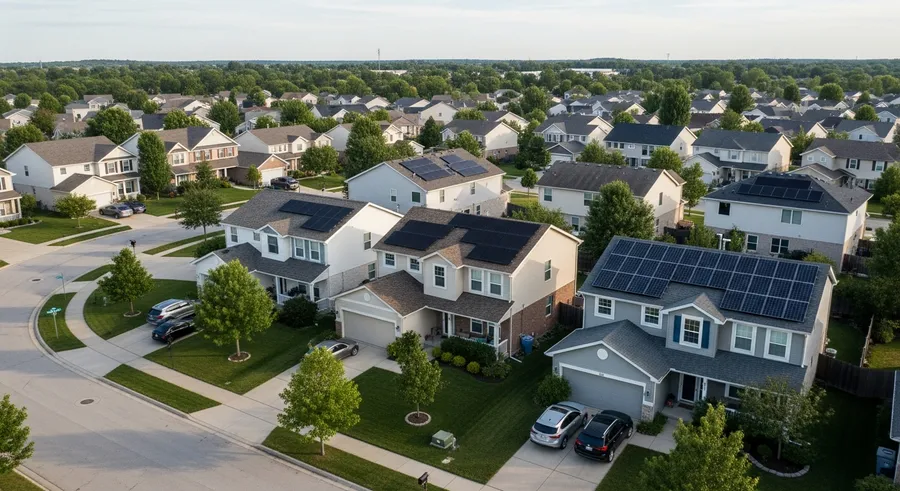
The phrase "25-year solar warranty" sounds simple. It is not. A residential solar project usually has at least three separate warranty documents: a module warranty from the panel manufacturer, an inverter warranty from the inverter manufacturer, and a workmanship warranty from the installer. Those documents cover different failures, run for different periods, and pay out in different ways.
The practical review is straightforward: identify who is responsible, what failure triggers coverage, how long coverage lasts, what labor is included, and what happens if the installer is no longer in business.
The three warranty documents
Module warranty. Solar panels usually carry a product warranty and a linear power warranty. The product warranty covers defects in materials or manufacturing. The linear power warranty promises that the panel will still produce a specified percentage of its original rated output after a stated number of years, commonly 25 years. The details vary by manufacturer. Some premium modules have longer product coverage. Some budget modules keep the long power warranty but shorter product coverage.
Inverter warranty. The inverter is the power electronics layer. Microinverters, optimizers, and string inverters each have different coverage periods. Many microinverter warranties run 25 years. Some string inverters are closer to 10 or 12 years unless an extension is purchased. A long panel warranty does not automatically extend the inverter warranty, and inverter replacement can involve real labor cost if labor is not covered.
Workmanship warranty. This is the installer warranty. It covers the work of installing the system: roof attachments, flashing, conduit, electrical workmanship, racking assembly, and commissioning. Workmanship terms vary widely. Some installers offer 5 years. Some offer 10. Some advertise 25 years, but the important question is what the warranty actually covers.
Roof penetrations must be explicit
The workmanship warranty should specifically cover roof penetrations and flashing. Solar racking attaches to the roof structure, and a good installation uses flashing and sealant methods appropriate to the roof type. A vague workmanship promise is not enough if a roof leak appears two winters later.
The contract should say whether the installer covers leaks caused by solar penetrations, how the claim is inspected, whether interior damage is excluded, and whether coverage is voided if another contractor works on the roof. Many installers will not warranty work on an aging shingle roof past roughly 15 years because the roof itself may fail before the solar attachments do.
What manufacturer warranties actually pay
Manufacturer warranties are not blank checks. A panel manufacturer may replace a defective module or provide a prorated remedy, but the warranty may not cover diagnosis, removal, shipping, reinstallation, roof access, or lost production. Inverter warranties can be similar. The equipment part may be covered while labor remains a separate cost.
That distinction matters if the installer is still active and willing to handle the claim. It matters more if the installer has closed. A homeowner can hold a manufacturer warranty and still need to hire a different contractor to diagnose, remove, and replace a failed component. A strong contract states who pays labor during the warranty period and whether the installer or manufacturer manages the claim.
Production guarantees are not the same as production estimates
Solar proposals often include a 25-year production forecast. The forecast may be based on weather data, roof orientation, system size, shade, panel degradation, and utility rate assumptions. It is not automatically a guarantee.
A useful quote should identify whether the annual production estimate is a P50 or P90 style model. A P50 estimate is the middle-case estimate: in a normal statistical frame, actual production is expected to be higher half the time and lower half the time. A P90 estimate is more conservative: production should exceed that value in most modeled years. P90 is less exciting in a sales proposal, but it is often the better number for financing decisions.
If the installer offers a production guarantee, the contract should explain the remedy. Does the installer pay cash for missed kWh? Does the guarantee exclude weather variation, shade growth, monitoring outages, homeowner-caused downtime, utility outages, or inverter failures? Does the remedy begin in year one or only after a multi-year true-up? A guarantee with broad exclusions may be less useful than the headline suggests.
If the installer goes out of business
Installer failure is the hard case. The panels and inverter may still have manufacturer warranties, but the workmanship warranty usually dies with the installer unless backed by an insurance product, third-party administrator, or acquiring company. State consumer-protection agencies and program administrators can help document the issue, but they do not automatically create a new contractor obligation.
For financed systems, the FTC Holder Rule can preserve certain claims and defenses against the holder of a consumer credit contract when the seller's conduct gives rise to those claims. It is not a general warranty replacement. It is a legal protection tied to the credit contract and the specific facts. A homeowner facing this situation should keep the sales proposal, contract, loan documents, PTO records, monitoring screenshots, and written service requests.
State resources vary. Illinois customers may have Illinois Shines complaint channels if the project participated in that program. Wisconsin customers should check Focus on Energy program documentation and the Public Service Commission of Wisconsin for utility-facing issues. Colorado and Oregon customers should keep program and tariff records tied to the Colorado PUC or Oregon PUC, depending on the dispute. Incentive databases such as DSIRE are useful for finding current state-program references, but the program administrator remains the source for active complaint rules.
Questions that make warranties auditable
- Panel coverage: What is the product warranty, what is the linear power warranty, and what output percentage is promised in year 25?
- Inverter coverage: Is the inverter covered for 10, 12, 20, or 25 years, and is any extension included in the contract price?
- Labor coverage: Who pays for diagnosis, removal, shipping, and reinstallation during a manufacturer claim?
- Roof coverage: Does the workmanship warranty explicitly cover roof penetrations and leaks caused by solar attachments?
- Production guarantee: Is the production number a P50 estimate, a P90 estimate, or an enforceable guarantee with a stated remedy?
- Installer failure: What warranty obligations survive if the installer stops operating?
The bottom line
A 25-year warranty can be real and still incomplete. The panels may be covered for output, the inverter for a shorter electronics term, and the roof work only for the installer's workmanship period. The best contract does not blur those boundaries. It names them, assigns responsibility, and keeps the homeowner from discovering the limits only after something fails.