
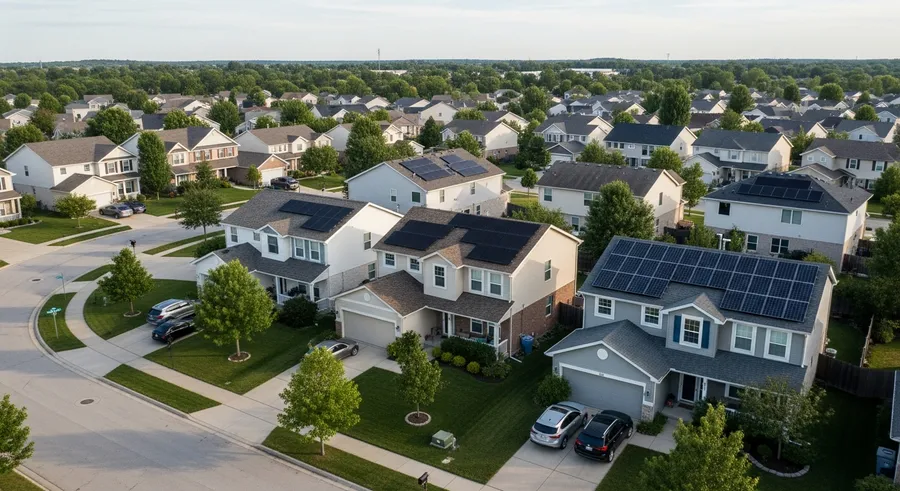
Solar in We Energies territory can work in 2026, but the proposal has to use the right export math. The common mistake is treating Wisconsin net metering as if exported electricity receives the same value as electricity consumed inside the home. That is not how the current We Energies customer-generation structure works.
For a homeowner in Brookfield, Wauwatosa, Mequon, New Berlin, or nearby Milwaukee suburbs, the core distinction is between self-consumed solar and net exported solar. The first offsets a retail bill. The second is compensated near the utility's avoided-cost buy-back rate, which is far lower than retail.
Avoided cost is not retail
Under We Energies customer-owned generation rules, solar electricity used by the house during the same billing interval avoids the retail delivered cost of electricity. That is the valuable portion of the system's production. Solar electricity exported after the home has already met its load is treated differently. The utility's 2026 customer-generation materials list buy-back treatment for qualifying systems, and current local modeling commonly uses an avoided-cost export value near 4.2 cents per kWh. Current tariffs and rate sheets should be verified against We Energies customer-owned generation resources and the Public Service Commission of Wisconsin before signing.
The gap matters. A kilowatt-hour consumed at the house may avoid a delivered retail cost several times larger than the avoided-cost export value. A proposal that models exported solar at the same value as retail consumption will overstate savings for many Wisconsin homes.
This does not make solar a bad fit by default. It makes Wisconsin less forgiving of generic annual-offset math. The winning system design is the one that keeps more production behind the meter.
Self-consumption drives the result
In a retail net-metering market, a homeowner can often think in annual terms: how many kWh the house uses, how many kWh the roof produces, and what percentage of usage is offset over the year. In We Energies territory, annual production is only part of the answer. Timing matters.
A Brookfield home with a daytime HVAC load, work-from-home occupancy, a pool pump, or daytime EV charging may consume a healthy share of production as it is generated. A Wauwatosa bungalow with low daytime use and heavier evening load may export more of the same-sized array's output. The second house can still benefit from solar, but the blended value of each produced kWh is lower unless the load profile changes.
That is why the useful quote question is not only system size. It is self-consumption share. The proposal should show how many annual kWh are expected to be used inside the home and how many are expected to export at the avoided-cost rate.
Batteries and load shifting change the Wisconsin case
Battery pairing matters more in Wisconsin than in a state with full retail export credit. A battery can store midday production that would otherwise export near avoided cost, then discharge it during evening household use that would otherwise be bought at retail. Round-trip losses still matter, and batteries add real upfront cost, but the avoided-cost spread gives storage an economic role beyond backup power.
Load shifting is the cheaper version of the same idea. Running a heat-pump water heater, dishwasher, laundry, pool pump, or EV charging session during the solar production window can convert low-value export into higher-value self-consumption. The discipline does not need to be perfect. Even a modest shift in daytime use can improve the system's blended value.
The strongest Wisconsin proposals usually include one of three designs: a smaller array sized around daytime baseload, a solar-plus-battery system designed around evening load, or a phased plan that leaves battery integration technically clean later. A proposal that simply fills every available roof plane and assumes the grid will make the timing mismatch disappear should be treated with caution.
Focus on Energy adds a real deadline
Wisconsin's Focus on Energy rebate is one of the few remaining 2026 residential incentives that directly improves the cash math. The current residential solar program states that applications must be submitted within 60 days of completed installation and no later than August 31, 2026. The program page also lists the 2026 single-family rebate structure, subject to program rules and available funds, at Focus on Energy Solar for Homes.
The date should be treated as a real planning constraint. Interconnection, permitting, installation, and inspection can run long in peak season. A late-summer contract should not assume the current rebate unless the installer can show a credible schedule that clears the application deadline.
The federal Section 25D credit is a separate issue. It expired for 2026 cash and loan installs, so a Wisconsin quote should not subtract a homeowner-claimed 30 percent federal credit from the price. The IRS Public Law 119-21 FAQ is the authority check.
What this means for Milwaukee-area suburbs
Brookfield, Wauwatosa, and Mequon all have plenty of homes where solar can pencil: owner-occupied single-family houses, meaningful electric usage, serviceable roofs, and enough roof plane for a clean array. The differences are in roof shape, tree cover, and daily load profile.
Brookfield and Mequon homes often have larger roof planes and higher total usage, which can support a larger system if daytime consumption or battery storage is part of the plan. Wauwatosa has more older housing stock and more tree-canopy variation, so a site-specific shade and roof analysis matters more. In all three markets, the export rate makes a right-sized system more defensible than a maximum-sized system unless the load profile justifies the larger design.
Production modeling should come from a source such as NREL PVWatts, using the specific ZIP, roof orientation, and shade assumptions. Incentive eligibility should be checked through Focus on Energy and cross-checked against DSIRE. Utility compensation should be checked against We Energies and PSCW material, not against a national solar article.
What to ask the installer
A Wisconsin solar proposal should answer these questions in writing: What avoided-cost export rate is used? How much production is modeled as self-consumed? How much is exported? Does the proposal include a battery, battery-ready equipment, or a load-shift plan? Is the Focus on Energy rebate assumed, and does the install timeline clear August 31, 2026?
If the proposal cannot separate retail offset from avoided-cost export, the payback model is not ready for review. Wisconsin solar is not a yes-or-no category. It is a timing and sizing problem, and the homes that solve that problem cleanly can still get a real return.