
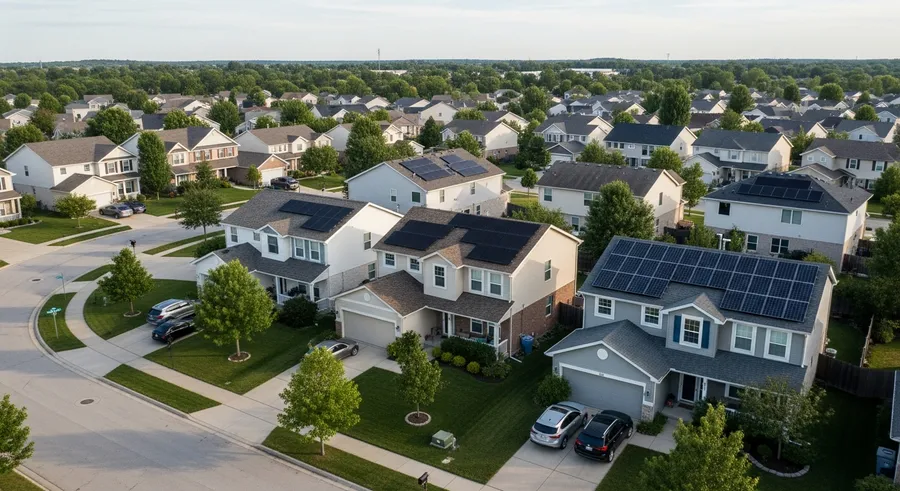
A household that plans to drive electric should size a solar system differently from a household that does not. The standard residential sizing question, how many kilowatt-hours per year does the home consume today, undercounts the future load of an electric vehicle by 3,000 to 5,000 kWh per year for a typical commuter. The right sizing question for a solar-plus-EV household is what the bill will look like two years out, not what it looks like today. The mechanics work out the same in every state, but the economics shift based on when the car charges and what the utility credits for exported solar.
The basic EV load math
A typical commuter EV drives roughly 12,000 to 15,000 miles per year and uses about 3 to 4 kWh per mile at the wall (this is wall-meter energy, not battery-meter energy, and it includes charging losses). The annual energy load is therefore in the 3,000 to 5,000 kWh range for a moderate commuter, and 6,000 to 8,000 kWh for a long-commute or two-EV household. A 7 kW residential solar array at typical Midwest production rates generates roughly 9,000 kWh per year, and at Front Range Colorado rates closer to 11,500 kWh per year. Adding an EV roughly doubles the displaced-load value of a residential solar install, which materially changes the sizing answer.
A pre-EV household sizing for its current bill might install a 5 or 6 kW system. A solar-plus-EV household sizing for the two-year-out bill should typically install 8 to 10 kW, sometimes more if there are two EVs or a long-commute pattern. Oversizing for the EV in advance is generally cheaper per watt than going back later and adding to an existing install, because mobilization costs (truck, crew, permit, interconnection) are sunk once and amortized over a larger system.
When the car charges matters more than how much
Whether the solar array actually offsets the EV charging load depends on what time of day the car is plugged in. Two patterns dominate residential EV charging.
Daytime charging means the EV is at home, plugged in, and pulling power between roughly 9 a.m. and 4 p.m. when the solar array is producing. This is the strongest economic pattern: every kilowatt-hour the EV uses during daylight hours is offset directly at the retail delivered rate, regardless of the utility's export-credit structure. Households with a remote-work pattern, a stay-at-home driver, or a Level 1 (120V, 12-amp) charger that takes 12 to 16 hours to fully charge a battery commonly fall into this pattern.
Nighttime charging means the EV is plugged in after the driver gets home, typically between 6 p.m. and overnight, with the array no longer producing. The household exports solar during the day and imports grid electricity at night to charge the EV. The economic value of the system in this pattern depends on the utility's export-credit treatment: a retail-NEM market (legacy Illinois, current Colorado Xcel, Oregon PGE) credits exports at the same rate as the evening grid pull, so the net effect is similar to daytime charging. A supply-rate or avoided-cost market (post-2025 Illinois ComEd, Wisconsin We Energies) credits exports below the evening rate, so the household effectively pays the gap to charge the EV from imported grid power.
The Illinois Smart Solar Billing structure (covered in the Illinois landing post) is the clearest case where charging time matters: daytime charging captures roughly 16 cents per kWh of value, while nighttime charging effectively sells the daytime production at 9.66 cents per kWh and buys it back at 16 cents per kWh. The 6 to 7 cent gap on every charging kilowatt-hour adds up to several hundred dollars per year for a typical commuter.
Charger level and what it implies
The charging hardware decides how much load the EV pulls at once and how long it takes to fill the battery.
Level 1 (120V, 12 to 16 amps) uses a standard household outlet and adds 3 to 5 miles of range per hour of charging. It works for short-commute households (under 30 miles per day) and pairs well with daytime solar because the load is small enough (about 1.4 to 1.9 kW continuous) that it sits inside the array's peak production for most of the day. Households with a daytime-at-home driver and a 7 to 10 kW array can charge a Level 1-connected EV entirely on solar with no grid import during sunny hours.
Level 2 (240V, 16 to 48 amps) uses a dedicated 240V circuit (typical garage installation) and adds 12 to 40 miles of range per hour depending on the amperage. The pull when charging (3.8 to 11.5 kW continuous) typically exceeds the residential array's peak output, so a Level 2-charging EV almost always pulls from a combination of solar and grid even on sunny midday charging sessions. The right way to think about Level 2 in a solar context is that the array offsets a meaningful share of the EV's charging load, not the entire load, and the unoffset portion is charged at the prevailing residential rate.
Households planning a Level 2 install during the same project as the solar install can sometimes share electrical service-upgrade costs across both improvements. An older home with 100-amp service typically needs an upgrade to support Level 2 charging plus solar interconnection, and bundling that upgrade into a single project is cheaper than doing it twice.
The federal EV credit picture in 2026
The federal EV tax credit framework changed materially under Public Law 119-21, and the eligibility rules for 2026 vehicle purchases require verification against current IRS guidance for the specific vehicle, model year, and household income. The federal credit was historically up to $7,500 for new EVs and up to $4,000 for used EVs under prior law; the 2026 picture is different and should be confirmed against the IRS credits-and-deductions guidance before treating any specific credit amount as available. State and utility EV incentives (including some rate-of-charge or off-peak charging rebates from select utilities) operate independently of the federal framework and should be verified through the utility directly or through DSIRE for the specific service territory.
What to ask the solar installer about the EV
A solar installer working a quote for an EV household should be able to answer four specific questions without hesitation.
- How are you sizing the array against expected EV load? The installer should have a method for projecting forward, not just sizing against the most recent 12 months of utility bills. A typical estimate is 3.5 kWh per mile at the wall multiplied by the household's projected annual miles.
- What time of day do you expect the EV to charge, and how does that interact with the local export-credit structure? If the installer cannot articulate the daytime-versus-nighttime trade-off for the local utility, the sizing recommendation is incomplete.
- If a Level 2 charger install is included, what is the electrical service capacity of the existing panel? Older homes with 100-amp service often need a service upgrade to accommodate both Level 2 charging and solar interconnection. The cost should be transparent on the quote, not buried.
- What battery storage option do you recommend, and why? A battery is not always the right add-on, but the answer should be reasoned against the specific household's charging pattern and the local export-credit rate. A blanket "everyone needs a battery" or a blanket "you do not need one" answer skips the analysis.
Bottom line
EV adoption changes the residential solar sizing answer in every state, and changes the economic structure of the install in markets where the export-credit rate is below retail. Daytime charging is the strongest economic pattern in every utility territory, and nighttime charging in supply-rate or avoided-cost markets creates a measurable gap that battery storage can sometimes close. Sizing for the two-year-out load, not the current bill, is the right starting point. The diagnostic walkthroughs at each state hub work the city-specific export-credit math, and the methodology page documents the production and rate inputs used throughout.